
500 kg/day Solar-Powered Flake Ice Machine
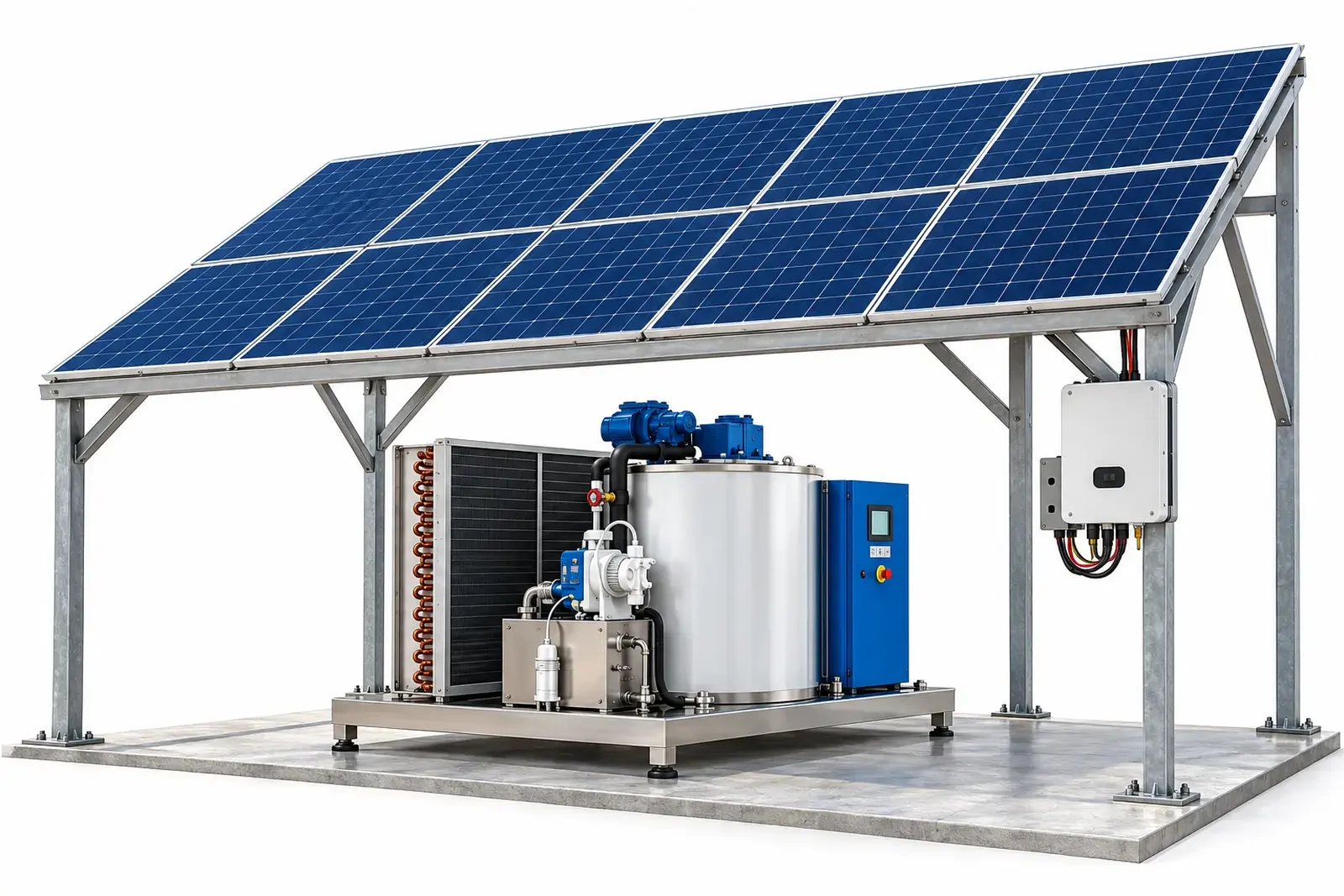
500 kg/day Solar-Powered Flake Ice Machine: Key Features and Commercial Benefits
Sustainable Ice Production Powered by Solar Energy
Access to reliable electricity remains one of the major challenges for fishing communities, aquaculture facilities and food businesses operating in remote locations.
In many coastal regions, islands and rural areas, ice is essential for handling fresh products, yet conventional ice production depends on an electrical infrastructure that may be unavailable, unreliable or expensive to operate.
The TAMUTOM Solar-Powered Flake Ice Machine – 500 kg/day offers an alternative approach by combining professional flake ice production with solar photovoltaic energy technology.
Designed around a 500 kg/day flake ice machine, the system enables solar-generated electricity to be used for ice production, helping businesses reduce their dependence on conventional electricity sources.
Rather than transporting ice over long distances or relying entirely on an unstable power supply, businesses can establish a local ice-production system designed around the available solar energy.
This makes solar-powered ice production particularly relevant for fishing villages, remote coastal operations, aquaculture projects, agricultural businesses and off-grid applications.
500 kg/day Ice Production Capacity
At the heart of the system is a professional TAMUTOM flake ice machine with a nominal production capacity of:
500 kg/day – approximately 20.83 kg/hour
The machine produces thin flake ice with an approximate thickness of 1.8–2 mm and an ice temperature of approximately -5°C.
Its thin structure and large contact surface make flake ice suitable for cooling and handling fish, seafood and other temperature-sensitive products.
The 500 kg/day capacity provides a practical starting point for small and medium-sized operations that require a local ice supply without investing in a large industrial ice plant.
Actual daily production depends on operating hours, available electrical energy, ambient conditions, water conditions and the selected solar power configuration.
How Does a Solar-Powered Flake Ice Machine Work?
The system combines conventional refrigeration technology with electricity generated from photovoltaic solar panels.
During daylight hours, solar panels convert sunlight into electrical energy.
This electricity is managed through the appropriate power conversion and control equipment and supplied to the flake ice machine.
Depending on the selected configuration, the installation may incorporate battery storage, grid support or another backup energy source.
A typical system can be designed around the following process:
Solar Panels → Power Conversion and Control → Flake Ice Machine → Ice Production → Ice Storage or Direct Use
Where battery storage is included, excess solar electricity may be stored for use when sunlight is insufficient, subject to the system's design and available battery capacity.
The photovoltaic array, inverter, battery system and other electrical components must be selected according to the ice machine's power requirements and the operating conditions of the installation.
Ice Production Where Conventional Electricity Is Limited
One of the most important advantages of solar-powered ice production is its potential application in locations where conventional electrical infrastructure is limited.
Fishing villages, islands and remote agricultural regions may be located far from established ice-production facilities.
In these locations, businesses may depend on ice transported from distant suppliers.
Transportation delays, delivery schedules and the cost of transporting ice can create operational challenges.
A solar-powered flake ice machine provides an opportunity to produce ice closer to the point of consumption.
This can help reduce dependence on external ice deliveries and improve control over daily ice availability.
For remote operations, producing ice locally can be just as important as the refrigeration technology itself.
Application Areas
Small-Scale Fishing Communities
Fishing communities are among the most important potential users of solar-powered ice machines.
Fish quality is strongly influenced by handling conditions after harvesting.
When ice is not readily available, maintaining appropriate product temperatures becomes more difficult.
A solar-powered flake ice machine can support local ice production near fishing landing points, allowing ice to be prepared for fish handling, temporary storage and transportation.
This solution can be particularly valuable for:
-
Small fishing villages
-
Artisanal fishing communities
-
Coastal fishing cooperatives
-
Remote fishing harbors
-
Fish landing stations
-
Island fishing operations
By producing ice locally, fishing communities can improve access to an essential cooling resource without relying entirely on distant commercial ice suppliers.
Aquaculture and Fish Farming
Aquaculture facilities frequently require ice during harvesting, sorting, handling and transportation.
Some fish farms operate in coastal or rural locations where electrical infrastructure may be limited.
A solar-powered ice-production system can provide an additional option for establishing a local ice supply.
Ice can be produced according to the available energy and operating schedule, while appropriately designed ice storage can help prepare for planned harvesting periods.
Potential applications include fish farms, aquaculture harvesting stations, shrimp farming operations and small seafood packing facilities.
Remote Islands and Coastal Facilities
Islands and remote coastal areas may face logistical difficulties in obtaining commercially produced ice.
A local solar-powered system can reduce the need to transport all required ice from another location.
The installation can be designed around the site's solar resources, water availability, electrical infrastructure and daily ice consumption.
For these applications, project-specific engineering is essential to determine whether a grid-connected, hybrid or battery-supported system is appropriate.
Agricultural and Fresh Produce Operations
Solar-powered flake ice production can also be considered for agricultural applications where ice is required for product cooling or handling.
Rural packing stations, fresh produce collection points and small food-processing operations may benefit from producing ice close to the point of use.
Where electricity access is limited, photovoltaic energy can provide an alternative source of power for the ice-production process.
Fish Markets and Small Food Businesses
Small fish markets, seafood retailers and food businesses may use flake ice for product display, handling and temporary cooling.
A solar-assisted system can help reduce reliance on purchased grid electricity when adequate solar resources and a suitable system configuration are available.
The 500 kg/day capacity is particularly relevant for operations with moderate daily ice requirements.
Advantages of Solar-Powered Flake Ice Production
1. Utilization of Renewable Solar Energy
Solar photovoltaic technology converts sunlight into electricity that can be used to operate the ice-production system.
This allows part or all of the required electrical energy to be supplied from a renewable source, depending on the system design and operating conditions.
The use of solar electricity can reduce reliance on conventional grid electricity or fuel-powered generators.
2. Reduced Dependence on Conventional Power Infrastructure
For locations with unreliable or limited electricity access, solar energy can provide an alternative electrical supply.
With appropriate system engineering, photovoltaic generation can be combined with batteries or backup power sources to meet the operating requirements of the installation.
This flexibility is particularly valuable in remote coastal and rural regions.
3. Potential Reduction in Operating Energy Costs
Electricity is an important component of ice-production operating costs.
Generating electricity from solar panels can reduce the amount of purchased electricity required by the installation.
The actual financial benefit depends on solar irradiation, electricity prices, system investment, operating hours, maintenance requirements and the selected energy configuration.
4. Local Ice Production
Producing ice directly at the point of use can reduce dependence on external ice suppliers.
For fishing communities and remote businesses, this can help minimize the logistical challenges associated with transporting ice over long distances.
5. Support for Cold-Chain Operations
Flake ice is widely used for handling fish, seafood and other temperature-sensitive products.
Having ice available near harvesting, processing or packing areas can support better temperature management during product handling.
A solar-powered system can help extend access to ice-production technology in locations where conventional power infrastructure presents a challenge.
6. Compact Production Capacity
The 500 kg/day flake ice machine provides a practical capacity for small and medium-sized operations.
It allows businesses to establish local ice production without requiring a multi-ton industrial ice plant.
The solar energy equipment can be designed according to the site's available space and energy requirements.
7. Flexible Energy System Configuration
Different sites require different energy solutions.
Depending on project requirements, a solar-powered ice-production installation may be designed as:
Grid-Connected Solar System: Solar electricity is used alongside the conventional electrical grid.
Hybrid Solar System: Solar energy is combined with grid electricity or another backup source.
Battery-Supported Solar System: Battery storage supports operation during periods when solar generation is insufficient.
The appropriate configuration must be determined through project-specific electrical and energy calculations.
Solar System Design and Energy Planning
A solar-powered ice machine requires more than simply connecting photovoltaic panels to conventional refrigeration equipment.
The complete energy system must be engineered according to the machine's electrical requirements.
Important project parameters include:
-
Daily ice-production requirement
-
Required operating hours
-
Electrical power consumption
-
Compressor starting characteristics
-
Available solar irradiation
-
Photovoltaic panel capacity
-
Inverter capacity and compatibility
-
Battery storage requirements, where applicable
-
Backup power availability
-
Ambient temperature
-
Water supply and water temperature
-
Installation location
-
Seasonal variation in sunlight
The correct photovoltaic system capacity depends on the electrical energy required to achieve the desired daily ice production under the site's operating conditions.
Why Solar Panel Capacity Matters
A machine rated at 500 kg/day does not automatically produce 500 kg of ice during daylight hours alone.
The nominal daily capacity is based on the ice machine's rated operating conditions.
To achieve the desired output using solar energy, the system must provide sufficient electricity over the required operating period.
Where the machine operates only during solar-generation hours, actual daily ice production may be lower than its nominal 24-hour capacity.
Where battery storage or an appropriate backup source is included, operation can potentially be extended beyond daylight hours.
For this reason, the photovoltaic system should be designed around the required daily ice output, not only the machine's nominal capacity.
Flake Ice Quality and Cooling Performance
The TAMUTOM 500 kg/day flake ice machine produces ice with an approximate thickness of 1.8–2 mm and a temperature of approximately -5°C.
The thin and irregular structure of flake ice allows it to be distributed around fish, seafood and other products.
Its large contact area supports effective heat transfer during product cooling.
For fishing and aquaculture operations, this makes flake ice a practical option for handling and temporary cooling applications.
A Project-Based Solar Ice Production Solution
Every solar-powered ice-production project has different requirements.
A fishing village on a tropical coastline may have different energy and operating conditions from an inland agricultural facility.
A site operating exclusively during daylight hours may require a different solar configuration from one that needs ice production during the night.
TAMUTOM's 500 kg/day solar-powered flake ice solution should therefore be configured according to the specific requirements of each installation.
The design process should consider both:
Ice Production Requirements + Solar Energy Availability
The objective is to establish an ice-production system in which the refrigeration equipment and the electrical energy infrastructure are appropriately matched.
TAMUTOM Solar-Powered Flake Ice Machine – 500 kg/day
The TAMUTOM Solar-Powered Flake Ice Machine – 500 kg/day combines professional flake ice production with the potential advantages of photovoltaic solar energy.
Designed for small and medium-sized operations, it provides a solution for businesses seeking to produce ice locally while reducing dependence on conventional electrical infrastructure.
With a nominal capacity of 500 kg/day, the system is particularly relevant for fishing communities, aquaculture facilities, remote islands, coastal operations and rural food businesses.
By combining suitable solar power equipment with professional ice-production technology, the installation can be engineered to meet the specific energy and ice requirements of the project.
Contact TAMUTOM to discuss a 500 kg/day solar-powered flake ice machine configuration suitable for your location, energy infrastructure and daily ice-production requirements.