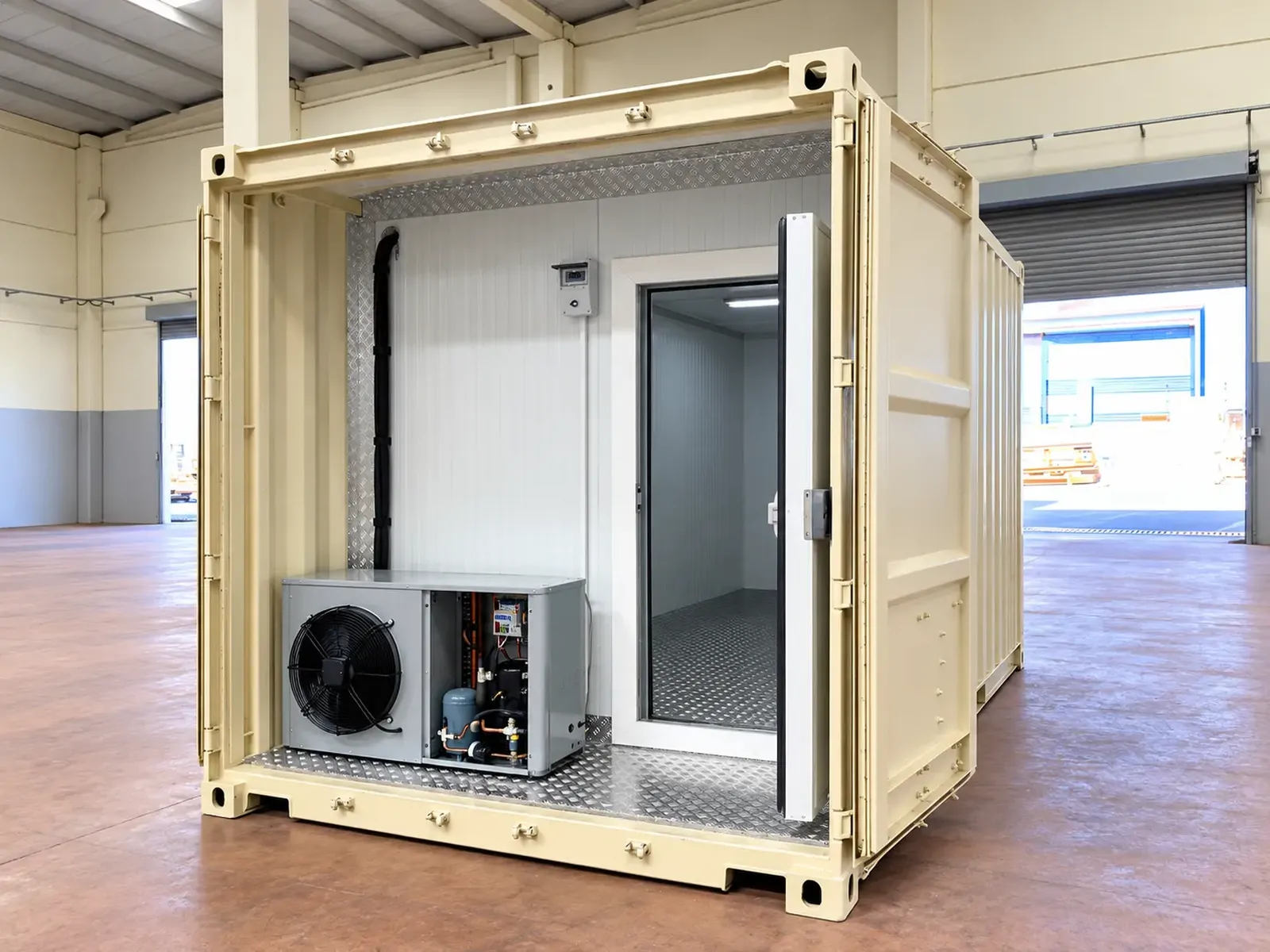
Mobile Ice Storage Wherever the Operation Needs It
Not every industrial ice storage requirement calls for the construction of a permanent storage room.
Fishing ports may need additional ice storage close to vessel loading areas. Aquaculture projects may operate at remote coastal locations. Seafood processing facilities may need additional storage capacity during periods of increasing production. Some projects may even require the ice-storage infrastructure to be relocated as operational requirements change.
The TAMUTOM Container Type Ice Storage System provides a practical alternative for these applications by integrating the storage environment into a standardized container-based structure.
Available in 20FT and 40FT configurations, the system provides a self-contained storage solution that can be positioned close to the ice-production or consumption area.
Instead of designing the facility around a permanently constructed storage room, the storage capacity can be brought closer to where the ice is actually required.
This creates a different approach to industrial ice storage:
Produce the Ice → Store It Close to the Operation → Keep It Available → Use It When Required
For fishing, seafood processing, aquaculture and remote industrial operations, this flexibility can provide an important advantage.
Why Container-Type Ice Storage?
A conventional ice storage room becomes a permanent part of the building.
A container-type system introduces a different concept:
the storage infrastructure becomes a modular part of the operation.
The unit can be planned as part of a new ice plant or integrated into an existing facility where additional storage capacity is required.
This can be particularly useful when:
-
Constructing a permanent storage building is impractical
-
Additional storage capacity is required at an existing facility
-
Ice must be stored closer to the consumption point
-
The project is located in a remote coastal area
-
The installation is expected to change or expand
-
A modular solution is preferred
-
Seasonal operations require additional storage infrastructure
The container format therefore provides more than physical storage space.
It provides installation flexibility.
Application Areas of Container Type Ice Storage Systems
Fishing Ports and Harbors
Fishing ports can have highly concentrated ice demand.
Several vessels may need ice within the same departure period, while the ice machines may have been producing continuously during the preceding hours.
A container-type storage unit can be positioned close to the vessel loading area, allowing ice produced earlier to be accumulated before the fleet requires it.
A typical operating concept can be:
Flake Ice Machine → Container Type Storage → Ice Transfer → Fishing Vessel
This helps create an operational reserve close to the point where the ice will actually be used.
For ports with changing layouts or limited available construction space, the container-based format can also provide greater flexibility than a conventional permanent storage room.
Commercial Fishing Fleets
Fleet operations are often governed by schedules rather than uniform consumption.
Multiple vessels may depart within the same few hours.
This creates a short but intensive demand period.
Instead of requiring the ice machine to produce the complete fleet requirement during this limited window, ice can be produced earlier and accumulated inside the container-type storage system.
When vessel loading begins, the stored reserve can support demand while the ice machine continues producing.
The result is a combination of:
Continuous Production + Stored Reserve + Peak Fleet Demand
This approach can help operators plan ice availability according to vessel schedules rather than instantaneous production alone.
Aquaculture and Fish Farming
Aquaculture projects can be located far from conventional industrial infrastructure.
Fish farms, coastal harvesting stations and marine aquaculture facilities may operate in locations where constructing a permanent ice storage building is not the preferred solution.
A containerized system can provide a practical storage point close to harvesting and packing operations.
Before a scheduled harvest:
Ice can be produced and stored in advance.
When harvesting begins:
The prepared reserve can be used while ice production continues.
This makes the system particularly relevant for:
-
Marine fish farms
-
Aquaculture harvesting centers
-
Shrimp farming operations
-
Coastal packing facilities
-
Remote fish farming projects
-
Island-based aquaculture operations
Seafood Processing Plants
A seafood processing facility may already have an established production building but later require additional ice-storage capacity.
Increasing production volume, adding another processing line or expanding operating hours can increase ice consumption beyond the original storage capacity.
In these situations, a container-type system can provide an additional storage solution without requiring the entire internal production layout to be redesigned around a new permanent room.
Depending on the project configuration, the unit can be positioned close to:
This makes containerized storage particularly useful for facility expansion and additional capacity projects.
Fish Markets and Distribution Centers
Fish markets and seafood distribution centers often operate within narrow time windows.
Products may arrive early in the morning and be distributed rapidly to retailers, restaurants, wholesalers or transport vehicles.
Ice demand can therefore rise sharply during receiving and dispatch periods.
A container-type ice storage unit allows a reserve to be prepared before these high-activity periods begin.
This helps separate the timing of ice production from the timing of ice consumption.
Islands and Remote Coastal Locations
Remote locations are among the strongest applications for containerized infrastructure.
Building conventional industrial facilities in isolated coastal areas or on islands can involve additional construction, logistics and installation requirements.
A container-based storage concept provides a standardized structure that can be incorporated into projects where mobility and modularity are important.
Combined with a suitable flake ice machine, the system can form part of a localized ice-production facility:
Water Supply → Flake Ice Production → Container Storage → Local Distribution
This can be useful for remote fishing communities, island operations, coastal collection points and aquaculture projects.
Advantages of Container Type Ice Storage Systems
1. Mobile and Modular Storage Concept
One of the most important advantages of containerized storage is flexibility.
The storage unit is not necessarily tied permanently to the internal architecture of a production building.
This allows the ice-storage infrastructure to be planned as a modular component of the overall facility.
For growing or changing operations, this can provide greater flexibility when planning future layouts.
2. Suitable for Existing Facilities
Increasing ice-storage capacity inside an existing facility may require structural changes.
A container-type system offers an alternative approach.
Additional storage can be positioned as a separate unit and integrated with the existing ice-production infrastructure according to the project layout.
This makes the concept particularly attractive for facility expansion projects.
3. Storage Close to the Point of Use
The distance between ice storage and ice consumption can affect the practical design of the entire system.
In large ports or industrial facilities, the production area may not always be located close to the final consumption point.
A container-type unit can be positioned strategically according to the site layout.
For example:
Ice Production Area → Transfer → Container Storage Near Vessel Loading Area → Vessel
or:
Ice Production → Container Storage → Processing Department
The objective is to place the storage capacity where it provides the greatest operational benefit.
4. Suitable for Remote Projects
Containerized systems are particularly relevant when the project is located away from conventional industrial infrastructure.
Remote fishing locations, coastal operations, islands and aquaculture sites may benefit from equipment designed around modular installation concepts.
The container format makes the storage system a clearly defined component within the overall project.
5. Supports Peak-Demand Management
Just like conventional industrial ice storage, a container system can help separate production time from consumption time.
When demand is low:
Produce and Store
When demand increases:
Use Stored Ice + Continue Production
This allows the ice plant to prepare for concentrated consumption periods.
6. Supports Future Capacity Expansion
An operation may begin with relatively moderate ice demand and grow over time.
More vessels may join the fleet.
Aquaculture production may increase.
A seafood plant may add another processing line.
A distribution center may handle larger volumes.
Container-type storage provides a modular approach that can be considered as part of future capacity planning.
7. 20FT and 40FT Alternatives
Different operations do not require the same storage volume.
The availability of 20FT and 40FT configurations allows the storage solution to be selected according to available space, ice-production capacity, consumption profile and project requirements.
The currently listed internal volumes are:
20FT → 22 m³
40FT → 44 m³
This provides two different starting points for project planning.
20FT or 40FT: Which One Should Be Selected?
Container size should not be selected only according to the physical dimensions of the project site.
The more important question is:
How much operational ice reserve does the facility actually require?
The decision should consider:
-
Daily ice production
-
Daily ice consumption
-
Maximum hourly consumption
-
Duration of peak demand
-
Required reserve
-
Ice machine capacity
-
Available installation area
-
Number of consumption points
-
Transfer requirements
-
Vessel schedules
-
Processing shifts
-
Aquaculture harvesting schedules
-
Future production growth
A smaller operation with relatively balanced consumption may be adequately served by a 20FT configuration.
A higher-capacity operation with concentrated demand periods may require the greater volume available from a 40FT system.
The correct selection should therefore be made according to the complete operational profile, rather than container size alone.
A Flexible Link Between Ice Production and Consumption
The value of a container-type storage system becomes clearer when the complete ice flow is considered.
Without storage:
Ice Machine → Immediate Consumption
With containerized storage:
Ice Machine → Container Storage → Controlled Availability → Consumption
This additional stage gives the operator more control over when produced ice is actually used.
It can help the facility prepare for vessel departures, processing shifts, harvest periods, loading operations and other predictable increases in demand.
TAMUTOM Container Type Ice Storage System
The TAMUTOM Container Type Ice Storage System provides a modular storage alternative for industrial operations requiring additional flexibility between ice production and consumption.
With 20FT / 22 m³ and 40FT / 44 m³ configurations, the system can be integrated into fishing ports, commercial fishing operations, seafood processing facilities, aquaculture projects and remote coastal installations.
Rather than treating storage as a fixed part of the building, the container concept allows it to become a flexible component of the overall ice-production infrastructure.
A complete project can therefore be planned as:
Flake Ice Production + Container Type Ice Storage + Ice Transfer + Ice Distribution
The appropriate configuration should be selected according to ice-production capacity, peak demand, required reserve, available installation area and the operating schedule of the facility.
Contact TAMUTOM to determine whether a 20FT or 40FT Container Type Ice Storage System is the appropriate solution for your fishing, seafood processing, aquaculture or industrial ice project.