
Flake Ice Storage System
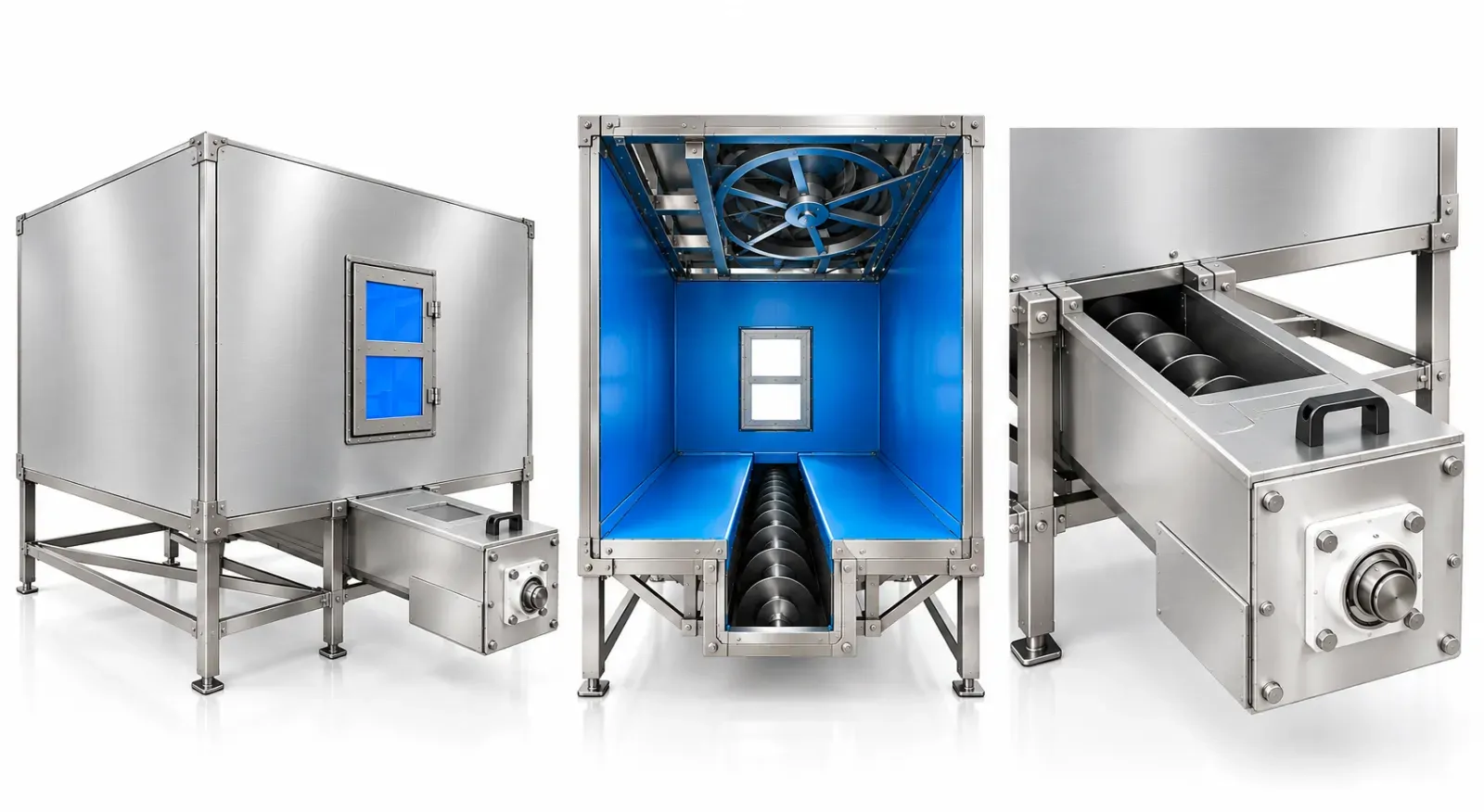
Flake Ice Storage System: Key Features and Commercial Benefits
Reliable Ice Storage Between Production and Consumption
Producing sufficient quantities of flake ice is only one part of an efficient industrial ice operation.
In many facilities, ice production and ice consumption do not occur at the same rate or at the same time.
A flake ice machine may operate continuously throughout the day, while the majority of the ice may be required during a much shorter production, loading, harvesting or processing period.
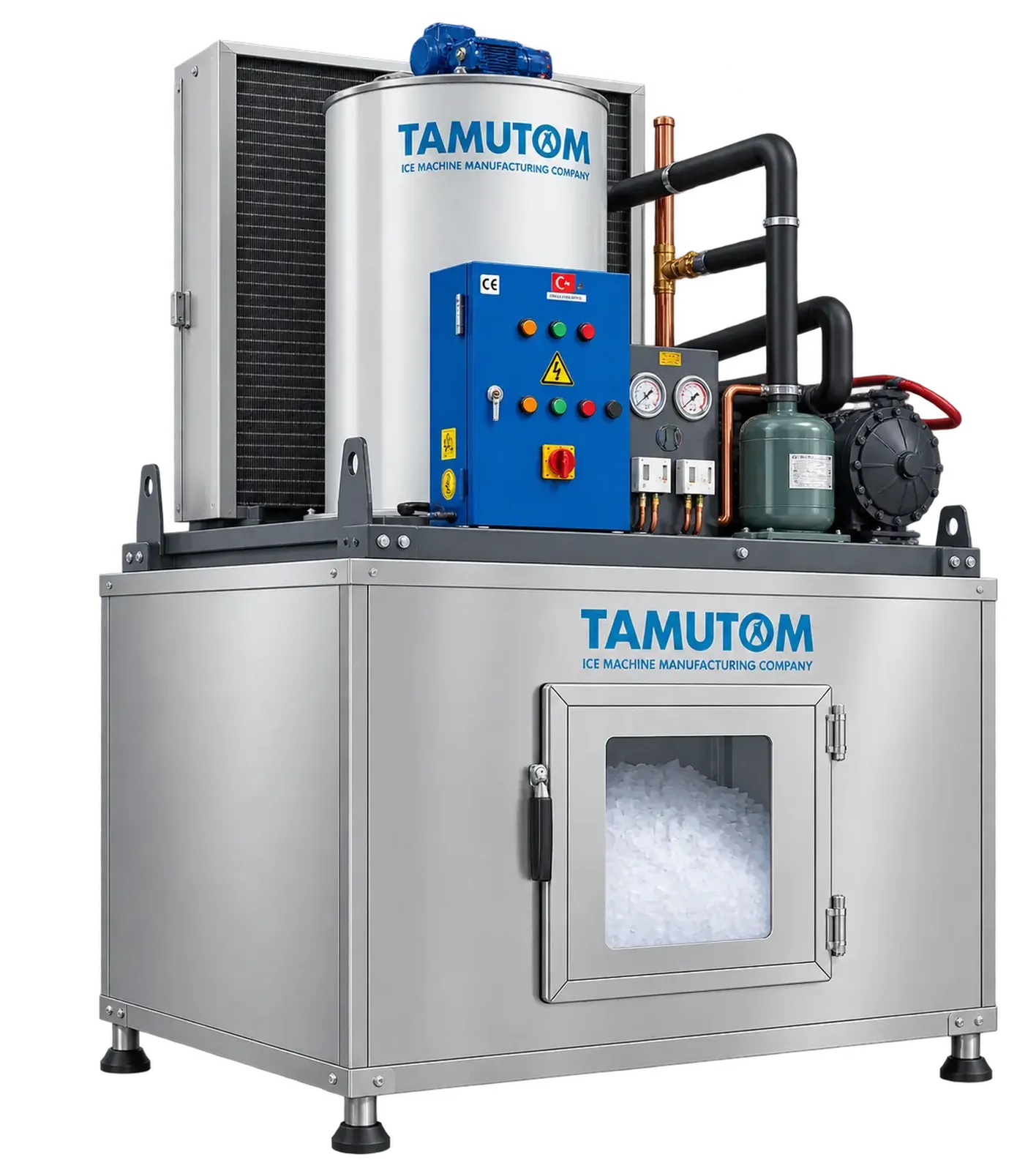
The TAMUTOM Flake Ice Storage System is designed to create the necessary operational buffer between these two processes.
It allows flake ice produced by the ice machine to be collected and stored until it is required, helping industrial facilities manage fluctuations between continuous ice production and variable ice demand.
Instead of requiring the ice machine to respond directly to every sudden increase in consumption, the storage system enables ice to be produced in advance and kept available for the next operational cycle.
This creates a more flexible relationship between:
Ice Production → Ice Storage → Ice Discharge → Point of Use
For facilities with high or irregular ice consumption, this storage stage can become an essential part of the complete ice plant.
Why Is Flake Ice Storage Important?
Industrial ice consumption is rarely completely uniform.
A fishing port may need several tons of ice within a few hours before vessels depart.
A seafood processing facility may experience its highest consumption when several production lines operate simultaneously.
An aquaculture facility may require a large quantity of ice during a scheduled harvest.
At other times of the day, demand may be considerably lower.
Without sufficient storage capacity, the ice machine would need to produce according to the highest instantaneous demand.
With an appropriately designed storage system, however, ice can be accumulated during lower-demand periods and used when consumption increases.
The operating principle becomes:
Continuous Ice Production → Ice Accumulation → Peak Demand → Controlled Ice Discharge
This allows production capacity to be used more effectively throughout the operating period.
Application Areas of Flake Ice Storage Systems
Fishing Ports and Commercial Fishing Fleets
Fishing ports are among the most important application areas for high-capacity flake ice storage.
Ice demand can increase significantly before vessels leave the port.
Several fishing vessels may require ice within the same limited time period, even though the ice machines have been producing continuously throughout the previous hours.
A storage system allows this production to be accumulated before vessel loading begins.
When the fleet is ready:
Stored ice can be discharged according to operational requirements while the ice machines continue producing.
This makes the system particularly suitable for:
-
Commercial fishing ports
-
Fishing harbors
-
Large fishing fleets
-
Fish landing centers
-
Vessel loading stations
-
Coastal fishing facilities
For these operations, storage helps transform continuous ice production into a reserve that can respond to concentrated fleet demand.
Seafood Processing Plants
Large seafood processing plants may use flake ice at several stages of production.
Ice may be required during:
-
Raw material reception
-
Fish unloading
-
Sorting
-
Grading
-
Processing
-
Intermediate handling
-
Packing
-
Temporary holding
-
Preparation for transportation
When multiple production lines operate simultaneously, demand may change considerably throughout the day.
A centralized flake ice storage system allows ice produced continuously by one or more machines to be accumulated and subsequently supplied to different production areas according to operational demand.
This makes it possible to integrate ice availability more effectively with the production schedule of the facility.
Aquaculture and Fish Farming
Aquaculture harvesting can create intense but predictable periods of ice consumption.
Fish or seafood may need to move rapidly through:
Harvesting → Sorting → Handling → Packing → Transportation
Instead of waiting until harvesting begins to produce all the required ice, the storage system allows the facility to prepare a reserve beforehand.
Ice production can begin hours before the scheduled harvest.
When harvesting starts, stored ice can be discharged while the ice machine continues producing.
This makes the storage system particularly useful for:
-
Marine fish farms
-
Aquaculture harvesting centers
-
Shrimp farms
-
Shellfish operations
-
Coastal packing stations
-
Fish farming facilities
The ice reserve can therefore become part of the harvest preparation process.
Fish Markets and Seafood Distribution Centers
Fish markets and seafood distribution centers frequently experience high ice demand during specific receiving and dispatch periods.
Products may arrive early in the morning, while distribution to retailers, restaurants or other customers may take place within a concentrated time window.
A flake ice storage system allows ice to be prepared before these periods begin.
The facility can therefore maintain a ready ice reserve instead of depending entirely on instantaneous ice production.
Food Processing Facilities
Flake ice is also used in different food-processing operations where controlled ice availability is required.
Depending on the production process, storage systems can support facilities such as:
-
Meat processing plants
-
Poultry processing operations
-
Food production facilities
-
Fresh product handling centers
-
Industrial preparation and mixing operations
The storage system can be integrated between the ice machine and the production area so that ice remains available according to the operating schedule.
Central and High-Capacity Ice Plants
As ice-production capacity increases, storage becomes increasingly important.
A high-capacity ice plant may contain one or several flake ice machines operating continuously.
Rather than sending all produced ice directly to consumption points, the production can first be directed to a centralized storage system.
A complete installation can therefore be organized as:
Flake Ice Machines → Flake Ice Storage → Ice Transfer → Distribution → Point of Use
This approach is particularly useful for facilities supplying several departments, production lines, vessels or external users from one central ice-production plant.
Advantages of Flake Ice Storage Systems
1. Balances Production and Consumption
One of the primary advantages of ice storage is its ability to compensate for differences between the rate of ice production and the rate of ice consumption.
The ice machine can continue producing during periods of low demand.
The resulting ice is stored.
When consumption exceeds the instantaneous production capacity, the stored reserve can support the operation.
This creates a simple operational balance:
Production > Demand → Store Ice
Demand > Production → Use Stored Ice
This principle allows the available ice-production capacity to be utilized more efficiently.
2. Helps Manage Peak Ice Demand
Peak demand is one of the most important considerations in industrial ice projects.
A facility may consume 10 tons of ice per day without consuming it evenly across 24 hours.
Several tons may be required within only a few hours.
The storage system allows part of this requirement to be produced before the peak begins.
Instead of sizing the entire installation only around instantaneous consumption, the project can combine:
Ice Production Capacity + Storage Capacity
to meet concentrated demand.
3. Creates an Operational Ice Reserve
Stored ice acts as a working reserve for the facility.
This can be particularly valuable before:
-
Fishing vessels depart
-
Seafood processing shifts begin
-
Aquaculture harvesting starts
-
Large product deliveries arrive
-
Packing operations begin
-
High-volume distribution periods start
The facility can enter these periods with a predetermined quantity of ice already available.
4. Supports Continuous Ice Production
Without storage, an ice machine may sometimes need to follow the changing consumption pattern of the operation.
With a storage system, production and consumption can be partially separated.
The ice machine can operate according to the planned production schedule while the storage system absorbs fluctuations in demand.
This can provide a more structured operating model for high-capacity industrial ice installations.
5. Reduces Dependence on Instantaneous Production
An industrial facility should not necessarily have to produce every kilogram of ice at the exact moment it is required.
Storage provides time flexibility.
Ice produced earlier can be used later during periods of higher consumption.
This becomes particularly important when the facility experiences short but intensive demand peaks.
6. Enables Centralized Ice Management
In large facilities, several departments or users may require ice from the same production source.
A centralized storage system can act as the intermediate point between ice production and distribution.
The system can be configured around the flow:
Central Ice Production → Central Storage → Multiple Distribution Points
This approach is suitable for:
-
Multiple processing lines
-
Several fishing vessels
-
Different production departments
-
Packing areas
-
Loading stations
-
Multiple ice consumption points
7. Supports High-Capacity Ice Plants
The larger the ice-production capacity becomes, the more important it is to manage when and where that ice will be used.
For high-capacity installations, storage should therefore be considered as part of the initial project engineering.
The correct system should evaluate:
-
Daily ice production
-
Daily ice consumption
-
Maximum hourly demand
-
Duration of peak demand
-
Required reserve
-
Storage capacity
-
Ice discharge rate
-
Transfer capacity
-
Number of consumption points
-
Distance between storage and usage areas
This allows the storage system to be matched to the real operating conditions of the facility.
8. Provides Flexibility for Different Operating Schedules
Not every facility operates continuously.
Some work in shifts.
Others experience concentrated morning or evening demand.
Fishing ports may follow vessel schedules.
Aquaculture facilities may follow harvest schedules.
Processing plants may follow production batches.
A storage system allows ice production to be planned independently from these short-term fluctuations.
This creates greater flexibility when coordinating ice production with the overall operating schedule.
Storage Capacity Should Follow the Demand Profile
Selecting a flake ice storage system should not be based only on the capacity of the ice machine.
For example, a 20 ton/day flake ice machine does not automatically require a 20-ton storage system.
The correct storage capacity depends on how and when the ice is consumed.
Consider two facilities using the same 20 ton/day ice machine.
The first consumes ice continuously over 24 hours.
The second requires most of its daily ice within an intensive six-hour period.
Although both facilities use the same production capacity, their storage requirements can be significantly different.
For this reason, system engineering should consider:
Hourly Production + Hourly Consumption + Peak Demand Duration + Required Safety Reserve
rather than daily capacity alone.
From Ice Machine to Complete Ice Management
A high-performance industrial ice installation is not defined only by how much ice the machine can produce.
The complete process must be considered:
Production → Storage → Transfer → Distribution → Consumption
If one stage cannot keep pace with the others, it may limit the practical performance of the entire system.
A storage system therefore provides the connection between continuous ice production and the variable demands of the operation.
For large fishing ports, seafood processors, aquaculture facilities and industrial ice plants, this makes storage an important part of overall ice-management infrastructure.
TAMUTOM Flake Ice Storage System
The TAMUTOM Flake Ice Storage System is designed to support industrial operations where flake ice must be produced, accumulated and made available according to changing demand.
Integrated with TAMUTOM flake ice machines and appropriate ice transfer or distribution equipment, the storage system can form part of a complete solution:
Flake Ice Production + Ice Storage + Ice Transfer + Ice Distribution
By balancing continuous production with variable consumption, the system helps facilities prepare for peak demand, maintain an operational ice reserve and organize ice supply according to the actual working schedule.
The appropriate storage configuration should be determined according to the ice-production capacity, peak consumption profile, required storage volume, discharge requirements and distribution layout of each project.