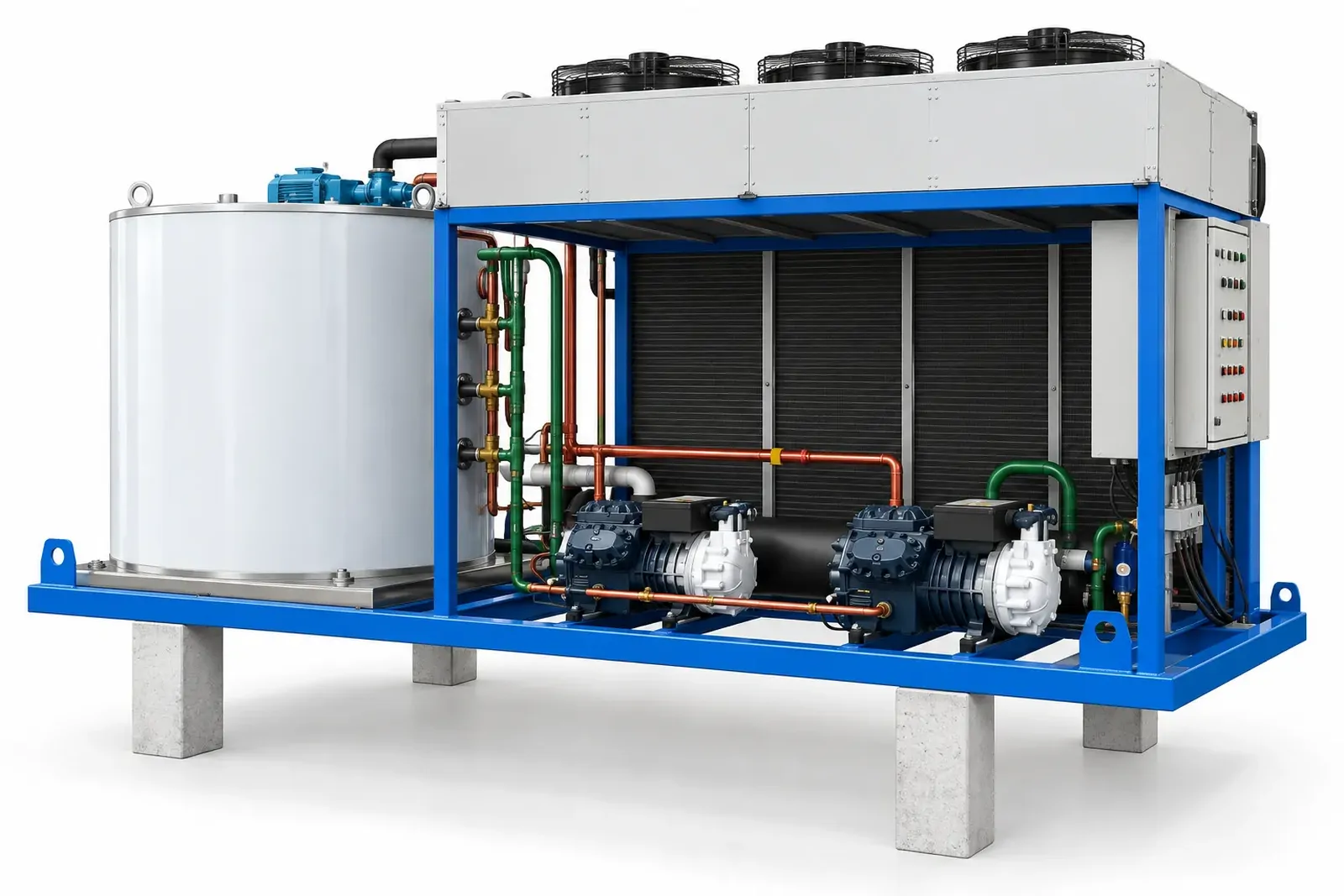
When Running Out of Ice Is Not an Option
In a large-scale fishing or seafood operation, insufficient ice is never simply a temporary inconvenience—it can quickly become a critical bottleneck throughout your entire production workflow.
Imagine your commercial fishing vessel standing ready to load ice, a massive volume of fresh catch arriving simultaneously at the port, multiple seafood processing lines running at full throttle, or an aquaculture harvest about to begin.
At such crucial moments, the question is not whether more ice can be ordered for the following day. Your facility needs high-performance flake ice right at that exact moment.
The TAMUTOM FIM20T-SW seawater flake ice machine is precision-engineered specifically for high-volume industrial operations where ice demand reaches critical thresholds.
With an exceptional nominal production capacity of 20,000 kg/day and approximately 833.33 kg/hour, this robust machine seamlessly supports demanding commercial fishing, seafood processing, and aquaculture operations where continuous flake ice production must keep pace with rigorous operational schedules.
At this scale, the primary purpose of an industrial flake ice machine goes beyond meeting average daily consumption. The key objective is providing sufficient production capacity to eliminate ice shortages entirely during your busiest operational peaks.
833.33 kg/Hour Changes Your Capacity Calculation
A daily production capacity of 20 tons is a powerful baseline figure, but for any serious industrial operation, hourly production capacity is often far more meaningful for daily logistics.
Under optimal nominal operating conditions, the TAMUTOM FIM20T-SW produces approximately:
833.33 kg of high-quality flake ice per hour
This hourly output translates directly into practical milestones:
- 2.5 tons in 3 hours
- 5 tons in 6 hours
- 10 tons in 12 hours
- 20 tons in 24 hours
This makes the 20,000 kg/day capacity directly applicable to the actual, fast-paced operating schedule of a busy fishing port, seafood processing facility, or large aquaculture enterprise.
For instance, if ice consumption slows down during night hours, production does not need to halt. Available production hours can be fully utilized to build a substantial strategic ice reserve.
When vessels begin morning ice loading, processing lines fire up, or an aquaculture harvest commences, your stored ice can be deployed alongside ongoing production.
Through this smart approach, production time itself transforms into a powerful capacity strategy.
The Real Question: How Much Ice Shortage Occurs During Peak Demand?
Evaluating your operations solely on average daily consumption often leads to incomplete capacity planning and unexpected shortages.
Consider two distinct seafood processing facilities that each consume 16 tons of ice per day.
The first facility spreads this usage evenly across 20 operating hours. The second facility consumes 10 tons during an intensive 8-hour production rush and the remaining 6 tons during off-peak hours.
While their total daily consumption is identical, their production and storage requirements differ significantly.
For high-capacity industrial projects, a much more effective formula is:
Ice Required During Peak Period − Ice Produced During the Same Period = Required Ice Reserve
This simple methodology fundamentally changes how a 20-ton/day flake ice system should be planned and integrated.
Your objective is not merely producing enough ice within a 24-hour window, but ensuring that ongoing production and stored ice reserves work seamlessly together to meet your facility's highest actual demand peaks.
Continuous Ice Production for High-Volume Seafood Operations
As the volume of products moving through your facility multiplies, the operational impact of insufficient ice increases exponentially.
Large-scale seafood facilities frequently perform multiple complex tasks simultaneously:
- Vessel unloading and catch intake
- Raw material receiving and inspection
- Sorting, sizing, and grading
- Industrial seafood processing
- Packaging and vacuum sealing
- Temporary product handling and staging
- Loading and logistics preparation
- Shipping and distribution dispatch
Each individual stage demands precise temperature control and specific quantities of ice. When multiple operations occur at once, total ice consumption spikes dramatically within a short timeframe.
Consequently, the TAMUTOM FIM20T-SW is specifically relevant for major projects where flake ice is utilized across the entire facility rather than confined to a single department.
At this industrial scale, the question is no longer simply "Which department needs ice?"
Instead, the critical question becomes:
"How much ice needs to be readily available when all departments operate simultaneously at full capacity?"
Addressing this challenge is one of the core operational strengths of our 20-ton/day capacity class.
Produce Industrial Ice Before It Is Needed
One of the most effective strategies to manage high ice demand is decoupling ice production time from ice consumption time.
Ice does not have to be generated at the exact millisecond of consumption; it can be manufactured in advance and safely stored to satisfy peak demand windows.
For example, picture a commercial fishing fleet initiating its ice loading routine at 05:00 AM.
Your industrial ice production system can run throughout the night, building a robust ice reserve before vessel loading even begins. When loading starts, several tons of premium ice are already waiting in storage while the FIM20T-SW continues uninterrupted production.
Your operational cycle can thus be structured efficiently:
Production → Ice Storage → Peak Demand Begins → Stored Ice + Ongoing Production → Reserve Replenishment
This sophisticated approach enables a machine's 24-hour production capacity to easily support much shorter, high-intensity consumption cycles.
A Capacity Class for Operations That Cannot Wait for Ice
At lower consumption scales, unexpected demand surges can sometimes be managed by purchasing emergency ice from external local suppliers.
At a true industrial scale, however, relying on external vendors becomes entirely impractical.
A busy fishing port cannot afford to wait for delayed external ice deliveries. A commercial fleet cannot alter departure schedules around third-party supplier availability. An aquaculture harvest cannot be postponed because of a local ice shortage.
Similarly, a modern seafood processing facility cannot tolerate interrupting lucrative production lines simply because its available ice reserve ran dry.
For these reasons, high-volume ice production capacity is inextricably linked to absolute operational continuity.
The TAMUTOM FIM20T-SW delivers an uncompromising, high-capacity ice production source that integrates smoothly into your facility's master schedule.
High-Volume Fishing Ports and Marine Infrastructure
Major commercial fishing ports experience multiple shifting ice demand cycles every single day.
Before vessels depart the harbor:
Substantial ice is required for vessel holds and cooling setup.
When fishing vessels return:
Ice is instantly required for safe unloading, catch handling, and raw reception.
When industrial seafood processing begins:
Continuous ice is mandatory throughout every processing phase.
During final packaging and shipping:
Additional ice ensures pristine freshness during logistics and staging.
Consequently, a single ice production plant must support diverse consumption periods throughout the day.
Boasting a powerful 833.33 kg/hour nominal production capacity, the FIM20T-SW is ideal for port-scale infrastructure where production runs continuously and storage buffers cushion intensive demand spikes.
This layout is exceptionally advantageous where multiple commercial fishing vessels and independent seafood businesses share a centralized ice supply and distribution network.
Calculate Fleet Peak Demand, Not Just Fleet Averages
The true ice requirement of a commercial fishing fleet should never be calculated by simply dividing total daily consumption evenly by 24 hours.
For instance, assume you manage 10 commercial vessels, each requiring 800 kg of ice.
Your total daily requirement equals:
8,000 kg
If all 10 vessels need to load their ice within the exact same four-hour morning window, your real operational requirement differs vastly from an even daily distribution.
During a four-hour window, the FIM20T-SW produces approximately:
3,333 kg
under standard nominal production conditions.
The remaining quantity is successfully covered by pre-produced ice drawn from storage before vessel loading begins.
This realistic example proves why high-capacity seawater flake ice systems must be engineered around your fleet's actual operating timetable, rather than simple daily tonnage numbers.
Seafood Processing Without Ice Becoming a Production Bottleneck
In large-scale seafood processing plants, overall facility capacity is measured by product throughput per hour.
As raw material flow increases, ice consumption scales upward in tandem. The primary engineering objective is ensuring your ice generation system matches the exact operating velocity of your plant.
The TAMUTOM FIM20T-SW excels across diverse industrial applications, including:
- Fresh fish receiving and sorting
- Whole fish handling and washing
- Automated sorting and grading lines
- Primary and secondary seafood processing
- Commercial shrimp and prawn processing
- Squid, octopus, and cuttlefish processing
- Intermediate product staging and cooling
- Retail and wholesale packaging
- Pre-shipment cold chain preparation
Producing fine, sub-cooled flake ice measuring approximately 1.8–2 mm in thickness at a temperature of around -5°C, the machine delivers a broad contact surface area that wraps perfectly around irregularly shaped seafood products without causing surface damage.
At this capacity level, however, superior physical ice quality is matched by the absolute reliability of having industrial quantities available on demand throughout your shifts.
Aquaculture: Plan Your Ice Before Harvest Day
Large-scale aquaculture harvests are highly organized, scheduled events.
Harvest dates are scheduled well in advance, estimated product volumes are calculated, and processing and packaging logistics are prepared weeks prior.
This creates a massive strategic advantage for facility managers:
Your required ice supply can be fully generated and secured before harvesting commences.
With an installed TAMUTOM FIM20T-SW system, ice production does not need to start simultaneously with harvesting operations.
An optimal operational sequence involves:
24 Hours Before Harvest → Ice Production Begins
Before Harvest → Strategic Ice Reserve Is Built
Harvest Begins → Stored Ice Is Deployed
During Harvest → FIM20T-SW Maintains Continuous Production
After Peak Demand → Ice Reserve Is Automatically Replenished
This sophisticated framework transforms ice production from a reactive measure into an integrated pillar of your harvest strategy.
This proven planning model is tailored for:
- Large marine fish farms
- Intensive shrimp production facilities
- Commercial aquaculture processing centers
- Coastal harvesting stations
- Seafood packing plants
- Regional aquaculture distribution hubs
Industrial Seawater Flake Ice Production
The TAMUTOM FIM20T-SW is purpose-built for high-efficiency flake ice production utilizing raw seawater.
Operating at a production level of 20 tons per day requires careful planning of your raw water supply as a core element of project engineering.
In coastal facilities, active fishing ports, and marine aquaculture zones, seawater is readily available in the surrounding environment.
Utilizing seawater allows coastal projects to build their ice infrastructure around local water sources, subject to appropriate intake filtration, water treatment, and installation protocols.
This specialized capability is vital for:
- Commercial fishing ports
- Remote islands and archipelagos
- Isolated coastal regions
- Marine aquaculture installations
- Coastal seafood processing plants
- Fish landing and auction centers
- Integrated portside seafood complexes
As industrial production capacity scales upward, professional water supply engineering becomes a cornerstone of successful project execution.
Ice Storage As Your Strategic Operational Reserve
Within a high-capacity ice production plant, the storage silo or bin should never be viewed merely as a container where excess ice sits idle.
An industrial ice storage system functions as your primary operational reserve.
Because your machine manufactures ice at a steady, controlled rate while facility consumption fluctuates dynamically:
Production > Consumption → Your strategic ice reserve increases safely.
Consumption > Production → Your strategic ice reserve bridges the gap.
The ultimate objective is preventing reserves from hitting critical lows before intense demand periods conclude.
This smart approach allows you to size your storage capacity according to accurate consumption profiles rather than arbitrary guesswork.
How Much Ice Storage Is Required for a 20-Ton/Day Ice Machine?
There is no single storage volume that fits every industrial installation.
A 20-ton/day flake ice machine does not automatically require a 20-ton storage bin; the ideal storage capacity depends entirely on when and how your facility consumes ice.
Scenario A – Continuous Production Facilities
If your facility distributes ice consumption evenly across 20 to 24 hours, production and consumption happen simultaneously, requiring a more compact buffer capacity.
Scenario B – Commercial Fishing Fleets
If the bulk of daily ice demand occurs during a narrow morning loading window, a larger storage reserve is mandatory to support peak outflow.
Scenario C – Aquaculture Harvest Operations
If consumption clusters tightly around scheduled seasonal harvests, ice must be accumulated beforehand in substantial dedicated storage silos.
Scenario D – Seafood Export and Distribution Centers
Multiple demand spikes occur daily due to staggered packaging, container loading, and shipping cycles, necessitating versatile storage solutions.
Therefore, correct ice storage sizing is determined by evaluating both how much ice your operation consumes and exactly when it is consumed.
Start Capacity Planning With Your Operation, Not the Machine
In high-capacity industrial investments, equipment should never be selected arbitrarily and forced into an ill-fitting operation.
Instead, a successful project begins by thoroughly understanding your unique operational workflow.
While the initial question is often:
How many tons of ice do we consume per day?
Several vital operational questions must also be addressed:
- How many kilograms of ice are required during your busiest peak hour?
- How long do peak consumption periods typically last?
- How many commercial vessels require simultaneous ice loading?
- What is your hourly seafood processing tonnage?
- How many active production lines operate concurrently?
- How much ice must be ready before the first morning shift begins?
- What reserve volume is required prior to an aquaculture harvest?
- How fast must stored ice discharge into transport systems?
- What distance must ice travel from storage to point of use?
The exact answers to these operational questions define your true system specifications.
Remember that the machine's generation capacity is only one component of a complete industrial ice production and distribution ecosystem.
Think in Tons per Hour, Not Only Tons per Day
In major industrial projects, focusing exclusively on daily output figures can cause crucial hourly bottlenecks to be overlooked.
The TAMUTOM FIM20T-SW generates approximately 0.833 tons of premium flake ice per hour under nominal operating parameters.
This hourly metric can be directly benchmarked against your facility's real-time consumption rates.
If average consumption stays below hourly production capacity, your system builds a valuable buffer reserve over time.
If demand surpasses 833.33 kg/hour during high-intensity periods, the deficit is easily met by pre-stored reserves.
This straightforward capacity model is expressed as:
Production > Demand → Store Ice for Peak Periods
Demand > Production → Utilize Stored Reserve Ice
Production = Demand → Maintain Perfect System Balance
Mastering this dynamic relationship is essential when designing a high-capacity flake ice infrastructure tailored for demanding real-world conditions.
Ice Transfer Speed Becomes a Critical Parameter
Producing and storing adequate quantities of ice represents only half the challenge; the ice must also reach the end user rapidly and reliably.
Picture multiple commercial fishing vessels waiting dockside to load ice. You may have ample ice stored in silos, but if your transfer conveyors or Rakes cannot deliver the required volume quickly, vessel turnaround times stall.
The identical principle applies to industrial seafood processing plants.
If multiple active production lines demand ice simultaneously, your distribution network must match the speed of your facility.
For a complete TAMUTOM FIM20T-SW project, engineering teams must evaluate the entire transfer chain:
Production Rate → Storage Capacity → Transfer Rate → Distribution Speed
The slowest link in this chain ultimately dictates the effective performance of your entire plant.
Plan Seasonal Peak Ice Demand in Advance
Ice demand across commercial fishing and aquaculture sectors rarely remains constant across all twelve months of the year.
While a facility might operate comfortably at standard capacity during off-peak months, ice consumption skyrockets during intensive fishing seasons or major harvest windows.
Consequently, designing your infrastructure around annual averages alone guarantees capacity shortfalls during peak seasons.
A comprehensive planning strategy accounts for:
- Normal daily ice consumption levels
- Daily consumption peaks during high season
- Maximum hourly ice demand rates
- Duration of peak consumption windows
- Required seasonal ice reserve buffers
- Available pre-season production time
- Anticipated future business expansion
The TAMUTOM FIM20T-SW should thus be evaluated not only against today's average consumption, but against the highest actual operational demands your facility expects to face.
From Ice Production to Comprehensive Operational Capacity
At lower scales, the primary objective is simply generating enough ice. At the 20-ton/day industrial tier, the goal becomes much broader:
Guaranteeing a continuous supply of ice throughout every phase of your facility's operational cycle.
To achieve this, facility engineers must plan four key elements in harmony:
Production
Storage
Transfer
Distribution
A fully integrated installation operates seamlessly through this flow:
Seawater Intake → FIM20T-SW Flake Ice Generation → Silo Storage → Automated Transfer → Distribution → Vessel / Processing / Harvest
Every single subsystem must be dimensioned to match your exact operational profile.
This engineering philosophy turns a high-capacity flake ice machine into a complete, reliable industrial ice production and distribution plant.
Where Is the TAMUTOM FIM20T-SW Suitable for Use?
The FIM20T-SW is custom-tailored for demanding projects where ice shortages would directly jeopardize operational continuity and profitability.
High-Volume Fishing Ports
Busy ports where numerous commercial vessels demand massive quantities of ice within tight loading windows.
Large Commercial Fishing Fleets
Commercial fleets featuring predictable schedules that nonetheless generate intense, high-volume ice demand spikes.
Industrial Seafood Processing Facilities
Plants operating multiple processing lines or continuous shifts where ice is consumed uninterrupted throughout the day.
Aquaculture Harvest Operations
Major fish farms and processing centers requiring pre-produced ice reserves ahead of scheduled seasonal harvests.
Seafood Export and Logistics Hubs
Facilities handling high product volumes through repeated packaging, palletizing, and shipping cycles every day.
Islands and Remote Coastal Operations
Isolated locations where transporting commercial ice from external suppliers creates prohibitive logistical hurdles and costs.
TAMUTOM FIM20T-SW – Capacity Engineered Around Real Ice Demand
The TAMUTOM FIM20T-SW seawater flake ice machine delivers a robust 20,000 kg/day nominal production capacity alongside an approximate 833.33 kg/hour hourly output for large-scale fishing, seafood, and aquaculture enterprises.
However, the true value of a 20-ton/day system can never be measured by output figures alone.
The vital consideration is whether a sufficient, uninterrupted supply of ice is instantly available when your facility hits maximum operational demand.
For this reason, successful FIM20T-SW installations integrate five essential parameters together:
Daily Demand + Peak Hourly Demand + Ice Reserve + Transfer Rate + Distribution Capacity
When these parameters are engineered into a balanced ecosystem, the FIM20T-SW transcends being merely a high-capacity flake ice machine.
It becomes the beating heart of your facility's industrial ice infrastructure.
Frequently Asked Questions About TAMUTOM FIM20T-SW
How much ice does the FIM20T-SW produce per day?
The TAMUTOM FIM20T-SW has a nominal flake ice production capacity of 20,000 kg per day, translating to an approximate hourly output of 833.33 kg per hour under optimal conditions.
Is the FIM20T-SW specifically designed for seawater?
Yes. The FIM20T-SW is the dedicated seawater version within the Tamutom flake ice machine lineup, purpose-built for efficient industrial ice production using raw coastal seawater.
Which operations benefit most from a 20-ton/day seawater flake ice machine?
The FIM20T-SW is ideally suited for high-volume commercial fishing ports, large fishing fleets, industrial seafood processing facilities, major aquaculture harvest operations, seafood export hubs, and remote coastal or island facilities requiring continuous ice supplies.