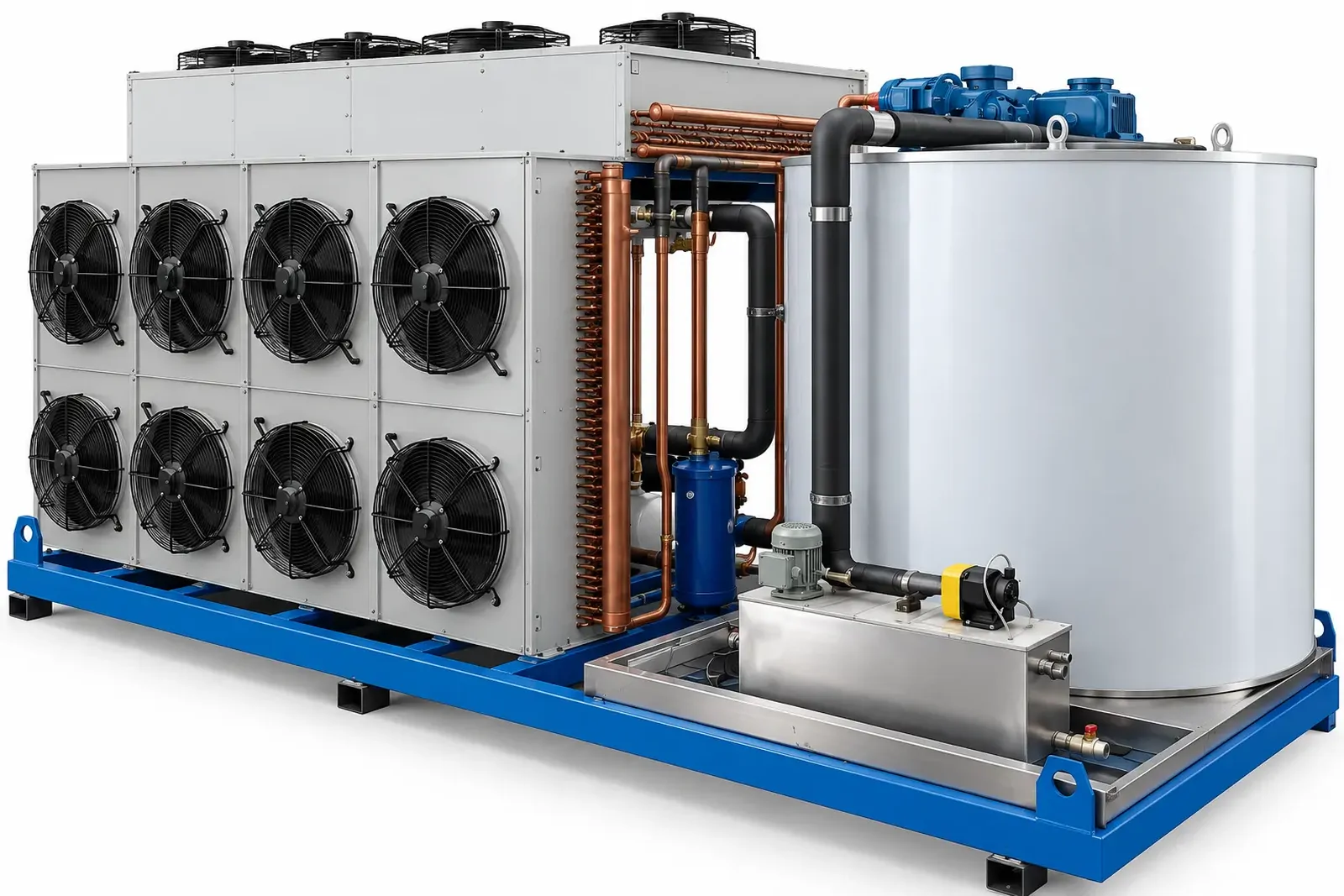
Central Ice Production for Large-Scale Marine Operations
A seawater flake ice machine with a 15-ton/day capacity can be used not only to produce large quantities of ice, but also to supply multiple consumption points from a centralized production system.
At a large fishing port, vessels, fish unloading areas, processing facilities and shipping points may require ice at different times. Therefore, planning should consider not only daily production capacity, but also when and where the ice will be required.
The FIM15T-SW can serve as the central production unit of an industrial ice production infrastructure planned around continuous production and centralized storage.
625 kg of Flake Ice Production per Hour
The nominal production capacity of the FIM15T-SW is 15,000 kg/day, or 625 kg/hour. This production rate allows ice production and storage to be planned together for operations with high ice demand.
During periods of lower consumption, produced ice can be stored as a reserve. When demand increases, stored ice can be combined with ongoing production to supply vessels, processing areas or harvesting operations.
This allows ice production to be planned according to peak hourly demand and the operating schedule, rather than daily capacity alone.
One Central Ice Production Point, Multiple Users
One of the key applications of the FIM15T-SW is centralized ice production. Instead of installing separate small ice machines for each user at a large fishing port or seafood complex, a central production point can be established.
Flake ice produced by the FIM15T-SW using seawater can be stored centrally and transferred to different locations according to operational requirements.
The system can support commercial fishing vessels, fish unloading areas, seafood receiving points, sorting areas, processing lines, packaging departments, aquaculture harvesting areas, fish markets and shipping areas from the same ice production infrastructure.
At this scale, the 15-ton/day ice machine can therefore become the production center of an integrated ice distribution network.
Central Seawater Ice Production for Commercial Fishing Ports
Ice demand at large fishing ports can vary throughout the day. Some vessels require ice before departure, while others return to the port and unload their catch. Seafood processing facilities in the same area may consume ice continuously.
Centralized ice production can therefore be particularly relevant at ports with high vessel traffic. The FIM15T-SW can serve as the production unit of a port-scale centralized ice system where ice is continuously produced and directed to different users according to demand.
This approach can turn ice production into a shared industrial resource rather than requiring each vessel or business to manage its own supply separately.
High-Capacity Ice for Large Commercial Fishing Fleets
Fleet size directly affects daily ice demand. In ports serving numerous commercial fishing vessels, demand can become concentrated within a short period around vessel departure and return times.
In such operations, daily production alone is not enough to evaluate capacity. Sufficient ice must be available during peak fleet demand.
The FIM15T-SW can be integrated into systems where continuous production and ice storage are planned together. Production can build an ice reserve during lower-demand periods, while stored ice can support high-volume distribution during fleet peaks.
Producing Ice and Having Ice Ready Are Not the Same
Producing 15 tons of ice per day and having the required quantity available at a specific time are different planning issues.
Even when total daily consumption is 12 tons, daily capacity alone may not be sufficient if most of that consumption occurs within a few hours. An appropriate ice reserve may need to be prepared before peak consumption begins.
For this reason, a professional system should consider production capacity + storage capacity + consumption rate + peak demand duration together.
The FIM15T-SW's nominal production rate of 625 kg/hour can help manage variable ice demand when combined with suitable storage and transfer infrastructure.
Ice Storage as Part of a Central Production System
At 15 tons/day, an ice storage system should be considered as an infrastructure component from the beginning of the project rather than as an auxiliary system added later.
Ice reserves become particularly important when several vessels depart at similar times, fish unloading operations are concentrated within certain hours, processing facilities work in batches or aquaculture harvesting takes place during defined periods.
Storage capacity does not automatically have to equal 15 tons. The required volume should be determined by considering production rate, consumption rate and peak demand duration together.
High-Volume Seafood Processing Facilities
In large seafood processing facilities, ice is rarely used at only one stage. Raw material receiving, sorting, grading, processing, intermediate handling, packaging and shipping may all depend on the same ice infrastructure.
When several production lines operate simultaneously, total ice consumption can increase rapidly. A centralized FIM15T-SW system can provide a common ice production source for different departments.
Flake ice can be used at different stages in facilities processing whole fish, fillets, shrimp, squid, cuttlefish and other seafood products.
Thin Flake Ice for High Product Volumes
The FIM15T-SW produces flake ice approximately 1.8–2 mm thick and at approximately -5°C. Its thin flake form provides a broad contact area and helps distribute ice around fish and other seafood products.
In industrial seafood operations, flake ice can be used for receiving, fish handling, icing of containers, sorting, processing, intermediate storage, packaging and shipping preparation.
This makes professional flake ice production an important operational component for facilities processing large volumes of seafood every day.
Large-Scale Aquaculture Harvest Operations
Ice demand in aquaculture facilities may vary throughout the year. Harvest periods can create intense operations in which large quantities of fish, shrimp or shellfish move through harvesting, sorting, packaging and shipping within a limited period.
Therefore, not only the amount of ice produced during harvesting but also the amount of ice that can be prepared before harvesting begins is important.
The FIM15T-SW can be operated before a planned harvest to build an ice reserve and continue production during harvesting while stored ice supports distribution.
This operating model can be considered for large fish farms, aquaculture harvesting centers, shrimp farms, shellfish operations and coastal packing facilities.
For Long Operating Hours and Multiple Shifts
Large seafood factories may operate for extended hours or across multiple production shifts. In these facilities, ice demand can extend from raw material receiving through processing and packaging to shipping.
With a nominal production capacity of 625 kg/hour, the FIM15T-SW can provide a high-capacity production infrastructure for projects with continuous and substantial ice requirements.
Capacity planning should consider the number of shifts, product volume per shift, ice consumption per ton of product, simultaneously operating lines, peak hourly demand, required ice reserves and seasonal increases.
Reducing Dependence on External Ice Supply
For a large operation, purchasing ready-made ice involves more than the purchase price. Supplier availability, delivery schedules, transportation, loading and unloading, temporary storage and seasonal supply are also part of the operation.
When daily ice consumption reaches high levels, ice logistics can become a significant operational requirement.
A centralized seawater flake ice machine allows an operation to plan its own ice production and reserve instead of managing incoming ice deliveries. For coastal facilities with access to seawater, this approach can connect ice production more directly to the operating schedule.
High-Capacity Flake Ice Production with Seawater
The FIM15T-SW is a 15-ton/day flake ice machine designed for seawater operation. This is particularly relevant to coastal fishing ports, seafood processing areas, aquaculture facilities and marine operations.
At facilities requiring high-volume ice production, the availability of a suitable water source near the production area is an important part of system planning. By operating with seawater, the FIM15T-SW provides a dedicated solution for coastal fishing and seafood operations.
When Should a 15-Ton/Day Seawater Flake Ice Machine Be Considered?
-
When multiple commercial fishing vessels require large quantities of ice
-
When a centralized ice production facility is planned for a port
-
When daily seafood processing volume is high
-
When multiple processing lines operate simultaneously
-
When the facility operates multiple shifts
-
When aquaculture harvest volumes are high
-
When smaller independent ice machines cannot meet peak demand
-
When external ice supply logistics become difficult
-
When centralized ice storage and distribution are required
For these projects, the FIM15T-SW should be considered not only according to average daily consumption, but also as part of the facility's capacity strategy and peak ice demand planning.
Designing the System Around Peak Ice Demand
A professional 15-ton/day ice system should be designed by evaluating the facility's complete operating profile. Daily ice consumption, maximum hourly demand, peak demand duration, number of fishing vessels, ice requirement per vessel, processed seafood volume, production lines and shifts are key parameters.
The aquaculture harvest schedule, required ice reserve, number of distribution points, transfer distance, seawater conditions, ambient temperature, installation area and electrical infrastructure should also be considered.
These parameters determine not only whether 15 tons/day is appropriate, but also the required storage and transfer infrastructure.
Production, Storage and Distribution Should Work as One System
At this capacity level, system performance does not depend on the ice machine alone. The complete system should be evaluated as a continuous flow:
Seawater → Flake Ice Production → Central Storage → Ice Transfer → Distribution → Point of Use
Even if the machine produces 625 kg of ice per hour, a transfer system that cannot move enough ice quickly during peak demand can create a bottleneck. Likewise, high transfer capacity cannot compensate for insufficient ice storage.
The project should therefore balance production capacity, storage capacity, transfer capacity and peak distribution capacity.
Infrastructure Ready for Future Capacity Growth
A 15-ton/day project should consider not only today's ice demand but also future business growth. A fishing port may add vessels, a seafood processor may add a production line or an aquaculture facility may increase harvest capacity.
Installation area, ice storage layout, transfer routes, electrical infrastructure and distribution points can therefore be planned with future requirements in mind.
The objective is not only to meet today's demand, but to establish an ice production infrastructure capable of supporting future growth.
Main Applications of the FIM15T-SW
Large Commercial Fishing Ports
For centralized ice production serving multiple vessels and seafood operations within a port.
Commercial Fishing Fleets
For high-volume ice supply coordinated with vessel departure and return schedules.
Seafood Processing Complexes
For supplying continuous ice requirements across multiple processing and packaging departments.
Aquaculture Harvest Centers
For producing and storing ice before intensive harvest periods and distributing it during harvesting.
Seafood Export and Distribution Centers
For centralized ice production supporting high product volumes, packaging and logistics operations.
Islands and Remote Coastal Areas
For local industrial ice production where transporting large quantities of ready-made ice creates logistical requirements.
Integrated Marine Industrial Zones
As a shared ice source for facilities where fishing, unloading, processing, packaging and distribution activities operate within the same area.
From an Ice Machine to a Centralized Ice Infrastructure
With its 15,000 kg/day capacity, the FIM15T-SW can become the production unit of a centralized ice infrastructure serving multiple users.
At this scale, the objective is not simply to produce 15 tons of ice. Continuous production, ice reserves, peak demand, transfer speed and multiple consumption points should all be planned together.
This is the key difference between installing an industrial ice machine and designing a complete centralized ice production and distribution system.
TAMUTOM FIM15T-SW – For Centralized Seawater Ice Production
With a nominal production capacity of 15,000 kg/day and a production rate of 625 kg/hour, the TAMUTOM FIM15T-SW is a high-capacity seawater flake ice production solution for large-scale fishing, aquaculture and seafood processing operations.
The FIM15T-SW can serve as the central production unit of complete ice systems combining seawater supply, flake ice production, ice storage, transfer and distribution.
Where multiple vessels, production departments or harvesting operations share the same ice source, the objective is not simply to answer “how many tons of ice does it produce per day?” The objective is to create an industrial ice infrastructure that considers when the ice is required, where it will be used and how quickly it must reach the point of use.
Frequently Asked Questions About the FIM15T-SW
How much ice does the FIM15T-SW produce per day?
The TAMUTOM FIM15T-SW has a nominal production capacity of 15,000 kg/day and a nominal hourly production capacity of 625 kg.
What type of water does the FIM15T-SW use?
The FIM15T-SW is designed to produce flake ice using seawater, making it suitable for coastal fishing ports, seafood facilities and marine operations.
Who is a 15-ton/day seawater flake ice machine suitable for?
It can be considered for large fishing ports, commercial fishing fleets, seafood processing facilities, aquaculture operations, seafood export and distribution centers and coastal facilities requiring centralized high-volume ice production.