When Ice Demand Becomes Part of the Production Plan
For a small fishing operation, ice can be purchased when it is needed. As operations grow, however, this approach becomes increasingly difficult to manage. A fishing port handling large daily landings, a seafood factory operating multiple processing shifts, or an aquaculture facility managing intensive harvest periods cannot afford to treat ice as an occasional supply item.
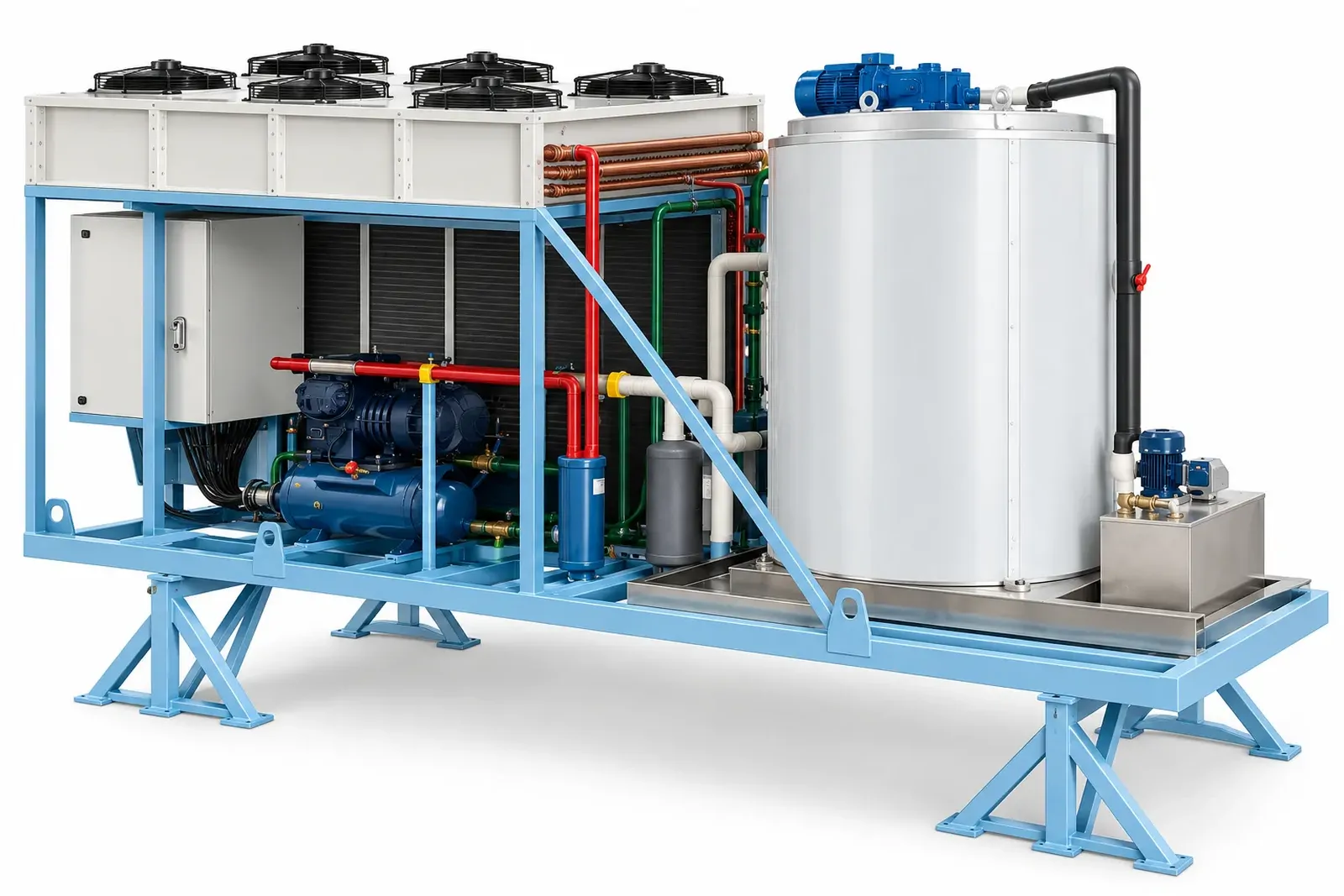
The FIM10T-SW is developed specifically for this level of operation, providing a dedicated industrial source of seawater flake ice directly where it is consumed.
10 Tons per Day: A Different Scale of Ice Production
A 10 ton/day machine should not be considered simply as a larger version of a small commercial ice maker; its role within an operation is fundamentally different. Operating at approximately 416.67 kg of ice production every hour, the FIM10T-SW supports operations where several tons of ice are consumed throughout a working day.
This capacity is particularly relevant when:
- Large quantities of seafood are landed every day.
- Several fishing vessels need ice simultaneously from the same facility.
- Processing continues through multiple shifts.
- Aquaculture harvesting creates concentrated ice demand.
- Ice must be fully prepared prior to vessel departure.
- Seafood receiving and processing occur concurrently.
The result is greater operational control over when, where, and how ice is available.
Technical Overview: FIM10T-SW Specifications
| Specification Parameter |
Technical Value / Feature |
| Daily Production Capacity |
10,000 kg / 24 Hours (10 Tons/Day) |
| Hourly Production Rate |
~416.67 kg / Hour continuous output |
| Ice Type & Temperature |
Seawater Flake Ice (~ -5°C) |
| Flake Thickness |
1.8 mm – 2.0 mm (Fast-cooling homogeneous structure) |
| Water Source |
Direct Seawater Feed (Anti-corrosive heavy-duty evaporator) |
| Operational Scope |
Landing → Receiving → Sorting → Processing → Packing → Dispatch |
Produce Ice Where Seawater Is Already Available
Coastal facilities have one significant advantage: the raw water source is right beside them. The FIM10T-SW utilizes seawater directly, which is critical because producing 10 tons of ice daily requires substantial water volume. Relying on municipal fresh water for this output adds unnecessary utility costs.
Typical installation environments include commercial fishing ports, seafood processing zones, aquaculture regions, island operations, and marine logistics hubs.
From Ice Purchasing to In-House Ice Production
Purchasing ice externally introduces risks such as rigid supplier schedules, transport delays, meltage during delivery, and stock shortages during peak seasons. Installing an industrial seawater flake ice machine shifts the facility mindset from "When will the next ice delivery arrive?" to "How much ice should we produce and store before the next harvest?"
Understanding the Real Capacity: 416.67 kg / Hour & Storage Integration
Fishing and seafood operations rarely consume ice at a constant rate throughout 24 hours. Demand fluctuates between high peak hours and low activity windows. For example, a port may require 3 tons of ice between 05:00 and 08:00.
The FIM10T-SW does not need to generate 3 tons during those 3 hours alone. When paired with an adequately sized ice storage silo, ice produced during low-demand periods is accumulated to create an operational buffer. The process follows a structured flow:
Flake Ice Production → Ice Accumulation → Peak Demand Buffer → Controlled Distribution
Frequently Asked Questions (FAQ)
In-house production eliminates transport logistics, melting losses, supplier price fluctuations, and delivery delays during peak harvest periods. Flake ice also cools product significantly faster than block ice without needing crushing equipment.
Storage sizing depends on your hourly consumption profile rather than total daily output. Facilities with concentrated consumption peaks require larger storage silos (e.g., 3 to 5 tons capacity) to serve high demand without delays.
Seawater salinity causes severe corrosion on standard metals. TAMUTOM seawater ice makers feature corrosion-resistant alloys, stainless steel components, and protective drum coatings designed for continuous marine operation.