A Reliable Ice Supply Begins Long Before the First Delivery
In commercial ice production, the busiest moment of the day is not always when the machine is running.
It may be when several fishing vessels request ice at the same time, when a seafood processing facility receives an unusually large shipment, or when a distributor must prepare multiple orders for different destinations.
During these moments, production capacity alone does not determine how effectively an ice supplier can respond.
The availability of finished ice, the organization of refrigerated storage and the timing of deliveries are equally important.
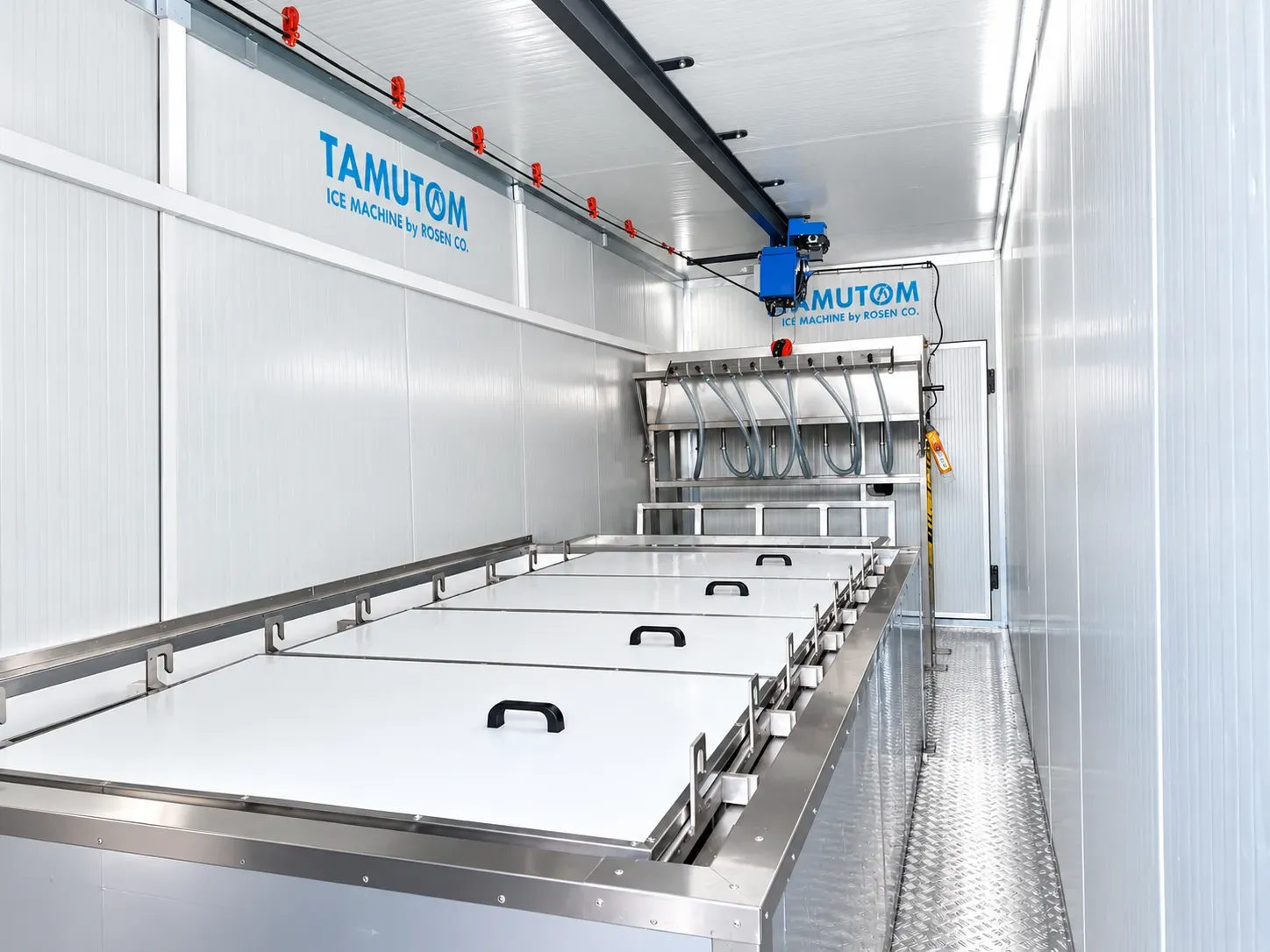
The TAMUTOM BIM5TCOS Containerized Block Ice Machine with Integrated Cold Room brings these essential elements together in one industrial installation.
With a nominal production capacity of 5,000 kg of block ice per day, standardized 15 kg ice blocks and a refrigerated storage compartment incorporated into a 40 FT insulated container, the BIM5TCOS is designed for businesses that require substantial daily ice production alongside an organized storage arrangement.
Rather than viewing ice manufacturing as an isolated process, the system supports a broader operational objective: producing ice, maintaining a usable reserve and preparing finished blocks for distribution according to business requirements.
For commercial ice suppliers, fishing ports, seafood processing facilities and industrial operations, this integrated approach can provide a practical foundation for managing daily ice demand.
Five Tons of Ice per Day: Understanding the Scale of Production
A five-ton daily production capacity introduces a different level of operational responsibility.
At this scale, ice is often produced for more than one customer, one department or one delivery.
A supplier may need to prepare several orders simultaneously.
A fishing cooperative may need to coordinate ice availability for multiple vessels.
A seafood processing facility may consume different quantities of ice throughout its receiving, processing and dispatch operations.
The BIM5TCOS is designed to meet these requirements through a structured block ice production process.
According to its published specifications, the machine produces 112 ice blocks per freezing cycle, with each block weighing 15 kg.
A complete production cycle takes approximately 7–8 hours.
Three complete cycles provide a calculated daily production of 336 blocks, corresponding to 5,040 kg of ice.
The machine is commercially rated at a nominal 5,000 kg/day.
The Real Challenge: Managing Ice Between Production and Delivery
Producing five tons of ice is one task.
Making that ice available at the right time is another.
Commercial ice demand is rarely perfectly synchronized with a machine's freezing cycles.
Consider a supplier operating near a major fishing harbor.
During the early morning, several vessels may require ice before departure. Later in the day, seafood traders may collect additional quantities for transportation. A processing facility may request another delivery before its evening shift.
The machine continues operating according to its production schedule, but customer demand follows a different rhythm.
Without suitable refrigerated storage, coordinating these activities becomes more difficult.
This is where the BIM5TCOS offers a distinctive operational arrangement.
Its integrated cold room provides a dedicated refrigerated space for holding finished ice blocks before collection, handling or dispatch.
Within the limits of its usable storage capacity, the cold room can help operators manage the time difference between production and consumption.
The benefit is not simply having a cold room next to an ice machine.
It is the ability to consider production schedules, finished ice storage and delivery planning as connected parts of the same operation.
An Integrated Ice Facility Inside a 40 FT Container
The BIM5TCOS combines its production equipment and refrigerated storage compartment within a standard 40 FT container insulated with sandwich panels.
This configuration creates a defined industrial installation in which two essential functions are brought together.
The production system manufactures solid ice blocks through a brine-type freezing process.
The integrated cold room provides an insulated, refrigerated compartment for holding finished ice before use.
For businesses developing a new ice supply operation, this arrangement can reduce the need to plan entirely separate locations for production equipment and refrigerated holding.
It may also simplify certain aspects of equipment layout and project coordination.
The containerized design is particularly relevant where businesses need to establish ice production close to the point of consumption.
Examples include fishing ports, seafood distribution centers, food processing facilities and selected industrial sites.
However, containerization should not be confused with installation without preparation.
The BIM5TCOS still requires appropriate electrical infrastructure, water supply, drainage, ventilation, structural support and access for operation and maintenance.
Transportation, unloading and commissioning must also be planned according to the conditions of the installation site.
A well-prepared location is essential for the reliable operation of the complete system.
The Integrated Cold Room: Supporting a More Organized Ice Supply
The refrigerated storage compartment is one of the BIM5TCOS model's most important distinguishing features.
According to the published technical data, the cold room includes:
-
Internal dimensions: 300 × 200 × 250 cm
-
Insulation: 100 mm sandwich panels
-
Refrigeration: Dedicated cooling unit
-
Installation: Integrated within the 40 FT containerized system
The insulated panels help reduce heat transfer between the refrigerated compartment and the surrounding environment.
The cooling unit supports the maintenance of suitable refrigerated conditions for finished ice.
The published product description indicates a cold storage operating range of approximately -5°C to -10°C.
Actual operating settings and performance should be confirmed according to the final system configuration and project requirements.
Why Does Integrated Storage Matter at Five Tons per Day?
At higher production volumes, the organization of finished ice becomes increasingly important.
Ice blocks must be removed from the production system, transferred to an appropriate holding area when necessary and prepared for their next destination.
The integrated cold room provides a dedicated location for part of this process.
It can support operations where ice is produced continuously but collected at different times.
It can also help businesses organize finished blocks according to expected orders or distribution schedules.
However, the cold room's dimensions do not establish its nominal ice storage capacity.
The quantity that can be stored depends on the usable internal volume, stacking configuration, handling access and operational requirements.
For this reason, the rated ice storage capacity should be confirmed separately from the machine's 5,000 kg/day production capacity.
This distinction is particularly important when planning large orders or periods of concentrated demand.
From Ice Production to Commercial Distribution
A commercial ice operation involves several connected stages.
The efficiency of the overall business depends on how well these stages are coordinated.
1. Production Planning
The first step is determining how much ice will be needed during the operating period.
Customer orders, expected demand and seasonal fluctuations influence the production schedule.
With a nominal capacity of five tons per day, the BIM5TCOS provides a production base for businesses serving multiple customers or operational departments.
2. Ice Manufacturing
Water is frozen into solid blocks through the machine's brine-type refrigeration system.
Each production cycle is designed to deliver 112 blocks weighing 15 kg each.
The approximate freezing period is 7–8 hours.
3. Ice Harvesting and Handling
After a production cycle is completed, finished blocks must be removed and handled using appropriate procedures.
The selection of handling equipment depends on the facility layout and operational requirements.
4. Refrigerated Holding
Blocks that are not immediately dispatched can be transferred to the integrated cold room, subject to its available storage capacity.
This creates an opportunity to manage finished ice separately from the production schedule.
5. Collection and Distribution
Customer orders can be organized according to the required number of blocks.
The standardized block weight supports quantity calculations and delivery preparation.
Transportation arrangements should be selected according to delivery distance, ambient conditions and the intended use of the ice.
These five stages demonstrate why a successful ice operation depends on more than the machine's production rating.
The entire process—from freezing to final delivery—must be considered during project planning.
Where the BIM5TCOS Can Make a Difference
Fishing Ports and Commercial Ice Supply Centers
Fishing operations often require substantial quantities of ice within relatively short periods.
Vessels may depart at different hours, return with varying catch volumes or require additional ice during unloading.
For suppliers serving multiple boats, the ability to manufacture and hold finished ice can support more organized daily operations.
The BIM5TCOS provides a nominal five-ton production capacity together with an integrated refrigerated storage compartment.
This combination can help harbor-based businesses coordinate production cycles with customer collection schedules.
Seafood Processing Facilities
Seafood processing operations depend on carefully managed product temperatures.
Ice may be used during receiving, sorting, handling and dispatch, depending on the products and processes involved.
Demand can change throughout the day as new shipments arrive or production schedules are adjusted.
The BIM5TCOS can serve as a local source of block ice while providing refrigerated holding for finished production.
Where direct product cooling requires smaller ice particles, appropriate crushing equipment may be incorporated separately.
All ice handling procedures should comply with the hygiene and food safety requirements of the intended application.
Wholesale Ice Distribution
Commercial ice distributors must balance manufacturing capacity with order preparation and delivery logistics.
A supplier serving fishing vessels, seafood traders and other commercial customers may receive orders at different times and in different quantities.
The BIM5TCOS produces standardized 15 kg blocks, allowing orders to be calculated by unit.
Its integrated cold room provides a refrigerated holding area for finished ice awaiting collection or dispatch.
This arrangement can support the development of a structured distribution process.
Food Processing and Cold Chain Operations
Certain food processing businesses use ice as part of their temperature-management procedures.
The suitability of block ice depends on the products, processing methods and required cooling performance.
Where appropriate, local ice production may reduce dependence on externally supplied ice.
The BIM5TCOS can be considered as one component of a broader temperature-management system.
Additional equipment may be necessary where crushed ice, automated transfer or specialized handling is required.
Agricultural Collection and Distribution
Some agricultural operations use ice to support product cooling during handling and transportation.
Collection centers and distribution businesses with substantial daily demand may benefit from a local ice production facility.
The BIM5TCOS can provide block ice production and refrigerated holding within one installation.
The appropriate ice form and cooling method should be determined according to the characteristics of the products being handled.
Industrial Cooling Applications
Industrial processes sometimes require large quantities of ice for temperature control.
In concrete production, ice may be used as part of a properly engineered cooling arrangement.
Since the BIM5TCOS produces solid blocks, additional equipment may be required for crushing, weighing, conveying and dosing the ice.
The machine should therefore be evaluated as a potential ice production component within a larger cooling system, rather than as a complete concrete cooling installation.
Why 15 kg Block Ice Is Suitable for Commercial Handling
The form of ice affects how it behaves during storage, transportation and use.
The BIM5TCOS produces solid blocks with a nominal weight of 15 kg each.
This standardized format offers several practical characteristics.
Predictable Quantities
Orders can be calculated according to the number of blocks required.
For example, a customer requesting approximately 300 kg of ice can be allocated 20 blocks of 15 kg.
This simplifies quantity planning and helps operators prepare deliveries in standardized units.
Compact Ice Structure
Compared with finely divided ice, a solid block generally has a lower surface-area-to-volume ratio.
Under comparable conditions, this means block ice tends to melt more slowly than smaller ice particles.
This characteristic can be useful during temporary storage and transportation.
Flexibility for Further Processing
Where an application requires smaller ice pieces, block ice can be processed using suitable crushing equipment.
The selection of additional equipment should be based on the required particle size, processing capacity and intended application.
Commercial Distribution
Standardized blocks provide a recognizable product format for customers purchasing ice by quantity.
They can support order preparation and inventory calculations, provided appropriate handling procedures are in place.
The most suitable ice type ultimately depends on the customer's application and cooling requirements.
Brine-Type Refrigeration Technology
The BIM5TCOS uses a brine-type freezing system for block ice production.
Water-filled molds are cooled through a refrigerated brine system until the water freezes into solid blocks.
This method is commonly used in industrial block ice production.
The published refrigeration specifications include:
-
30 HP compressor capacity
-
Air-cooled condenser
-
33,898 m³/h condenser airflow
-
R404A refrigerant
-
380–415 V / 3 Phase / 50–60 Hz power supply
The machine is designed to produce 112 blocks per cycle, with an approximate production period of 7–8 hours.
As with other industrial refrigeration systems, performance depends on operating conditions.
The air-cooled condenser requires sufficient ventilation and suitable airflow.
The integrated cold room also has its own refrigeration requirements, which must be considered when evaluating the installation's complete electrical and cooling infrastructure.
Planning a Five-Ton Ice Production Facility
A five-ton ice machine represents a significant daily production capability.
To make effective use of that capacity, businesses should evaluate the complete operating process before installation.
Determine Daily and Peak Demand
Average consumption is important, but peak demand can be equally significant.
A business may consume several tons of ice per day while requiring a large proportion of that quantity within a short period.
Production and storage planning should account for both conditions.
Match Storage Capacity to the Delivery Schedule
The integrated cold room can provide refrigerated holding for finished blocks.
However, its usable storage capacity must be sufficient for the intended operating arrangement.
The required reserve should be determined according to production cycles, customer collection times and expected delivery quantities.
Plan the Production Cycle
With an approximate cycle duration of 7–8 hours, the timing of ice harvesting should be incorporated into the daily operating schedule.
This is particularly important for businesses serving customers at fixed collection times.
Organize Handling and Movement
A production capacity of five tons per day involves moving substantial quantities of ice.
Appropriate procedures and equipment should be selected for harvesting, transferring, storing and dispatching finished blocks.
Evaluate the Installation Site
The 40 FT container requires a suitable location with adequate infrastructure.
Electrical supply, water connections, drainage, ventilation, ground support and maintenance access should be assessed before installation.
Consider Future Operational Requirements
Businesses expecting increased demand should evaluate whether their planned storage, handling and distribution arrangements can accommodate future growth.
Production capacity is only one part of the complete ice supply operation.
BIM5TCOS Compared with Smaller Cold Room Integrated Models
The BIM3TCOS, BIM4TCOS and BIM5TCOS share the same general installation concept: block ice production combined with refrigerated storage inside a containerized system.
Their main distinction is daily production capacity.
| Model |
Nominal Daily Capacity |
Block Weight |
Blocks per Cycle |
| BIM3TCOS |
3,000 kg/day |
12 kg |
84 |
| BIM4TCOS |
4,000 kg/day |
12 kg |
112 |
| BIM5TCOS |
5,000 kg/day |
15 kg |
112 |
Compared with the BIM4TCOS, the BIM5TCOS increases nominal daily production capacity by 25%.
It achieves this with a higher published block weight of 15 kg, rather than an increase in the number of blocks produced per cycle.
Compared with the BIM3TCOS, the nominal daily capacity is approximately 67% higher.
These differences can influence machine selection according to customer demand, preferred block weight and operating requirements.
However, higher daily production does not automatically mean greater storage capacity.
The integrated cold room must be evaluated independently to determine whether it can accommodate the required reserve.
The most suitable model depends on the relationship between production volume, storage requirements and the intended distribution schedule.
The Importance of Planning Beyond Production Capacity
When businesses invest in industrial ice equipment, attention naturally focuses on how many kilograms can be produced each day.
But commercial performance depends on a wider set of factors.
A machine may manufacture five tons of ice, yet the business must still determine how that ice will be handled.
It must decide when finished blocks will be transferred to storage.
It must organize customer orders and transportation.
It must ensure that suitable refrigeration and handling conditions are maintained until the ice reaches its intended destination.
The BIM5TCOS offers an integrated configuration that allows these requirements to be considered together.
Its value lies not only in the production of five tons of block ice per day, but also in the opportunity to organize refrigerated holding within the same installation.
For businesses operating in demanding commercial environments, this can provide a practical basis for developing a more structured ice supply process.
TAMUTOM BIM5TCOS – From Daily Production to Dependable Ice Availability
In a commercial ice business, the objective is not simply to complete another production cycle.
It is to ensure that the ice produced can be managed, preserved and prepared for the customers who depend on it.
The TAMUTOM BIM5TCOS Containerized Block Ice Machine with Integrated Cold Room combines nominal 5,000 kg/day production capacity, 15 kg solid ice blocks, industrial brine-type refrigeration technology and an integrated refrigerated storage compartment within a 40 FT insulated container.
This configuration provides a foundation for businesses seeking to coordinate ice production and storage within one industrial installation.
From busy fishing ports to seafood processing facilities and commercial distribution operations, the BIM5TCOS is designed to support a more organized approach to daily ice supply.
Five tons of ice production capacity. A dedicated refrigerated storage area. One integrated system built around the demands of commercial ice supply.