When Ice Demand Grows, Your Production Strategy Should Grow with It
For businesses that depend on ice every day, increasing demand brings a new set of operational challenges.
More customers mean larger orders. Longer operating hours create additional delivery requirements. Seasonal activity can make daily consumption difficult to predict.
At this stage, choosing an ice machine is no longer simply a matter of calculating production capacity.
The real question becomes: How can a business produce enough ice, preserve its available stock and maintain a dependable supply throughout the working day?
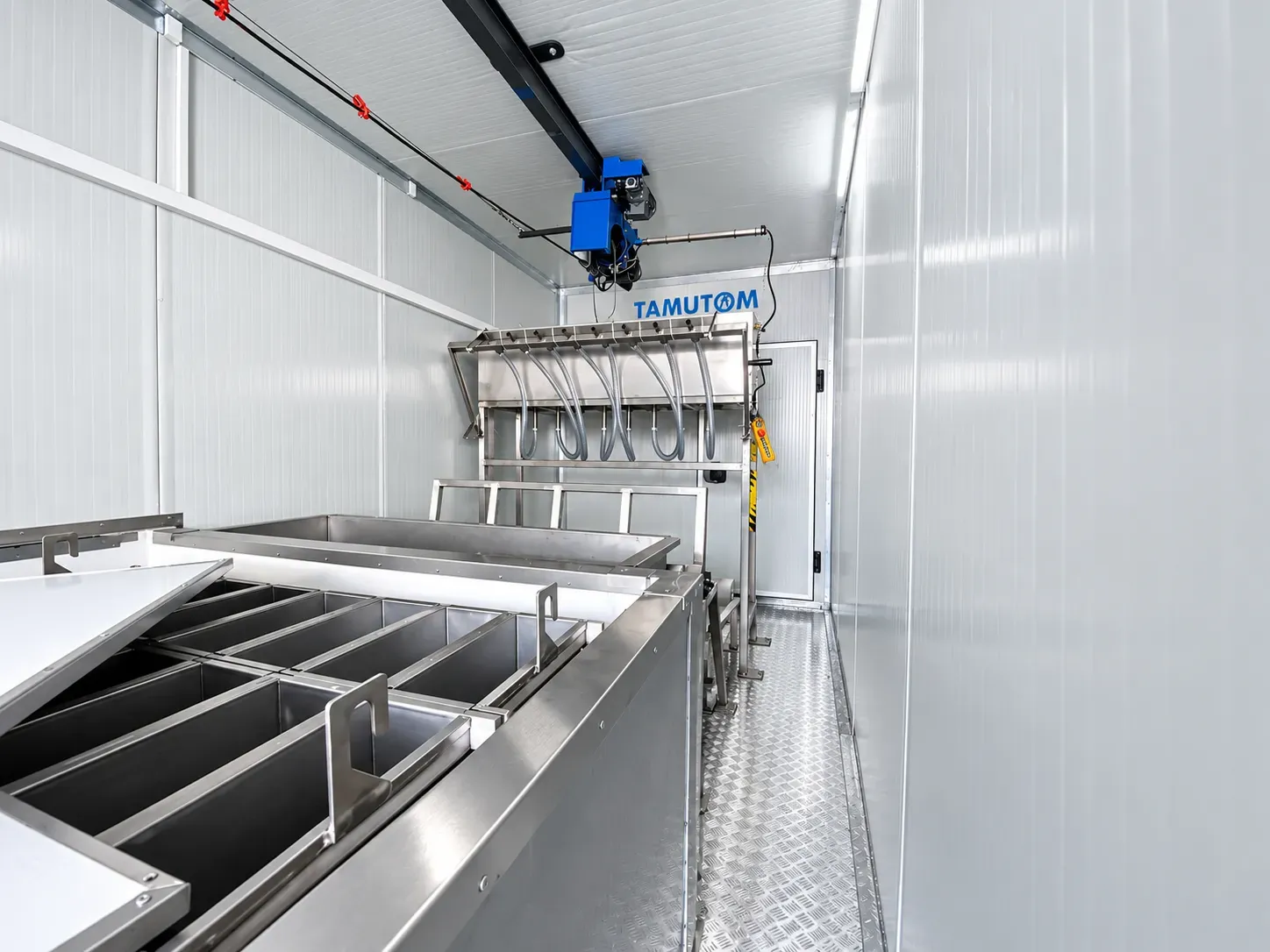
The TAMUTOM BIM4TCOS Containerized Block Ice Machine with Integrated Cold Room is designed around this challenge.
Combining a nominal production capacity of 4,000 kg of block ice per day with a refrigerated storage compartment inside a 40 FT insulated container, the BIM4TCOS brings two essential functions into one coordinated installation.
Its design is particularly relevant to businesses that require more than occasional ice production but want to maintain a practical, organized approach to manufacturing and storing finished ice.
From fishing harbors and seafood processing operations to commercial ice distribution and selected industrial applications, the BIM4TCOS offers a production-and-storage configuration for businesses managing substantial daily ice requirements.
Four Tons of Daily Production: Capacity That Supports Business Growth
A production capacity of four tons per day represents more than a technical specification.
For a commercial ice supplier, it can mean the ability to serve additional customers.
For a seafood processing facility, it can support larger daily handling volumes.
For a fishing cooperative, it can provide a production base for coordinating the needs of multiple vessels.
The BIM4TCOS is designed to manufacture solid block ice in standardized 12 kg units.
Its published production characteristics include:
-
4,000 kg/day: Nominal daily block ice production capacity
-
112 blocks: Ice production per freezing cycle
-
12 kg: Individual block weight
-
7–8 hours: Approximate production cycle
-
336 blocks: Daily block production
-
-12°C: Nominal ice temperature
Each production cycle delivers 112 blocks of 12 kg, representing 1,344 kg of ice.
Across three complete cycles, the calculated daily output reaches 4,032 kg, while the machine's commercial capacity is expressed as a nominal 4,000 kg/day.
These figures provide a foundation for planning production schedules, allocating customer orders and estimating daily handling requirements.
For example, an ice supplier receiving orders from several fishing vessels can determine the number of blocks required for each customer and organize production accordingly.
A seafood processing operation can coordinate ice availability with product intake and dispatch schedules.
A commercial distributor can plan daily deliveries around the expected quantity of finished blocks.
Actual performance depends on operating conditions, including inlet water temperature, ambient temperature and installation requirements.
The Operational Advantage of Combining Production and Storage
In many businesses, ice consumption does not occur at the same rate as ice production.
A machine may complete a freezing cycle at one point in the day, while customers may require the finished ice several hours later.
This creates a practical requirement: finished ice must be managed between production and use.
The BIM4TCOS addresses this requirement through its integrated cold room.
Rather than relying entirely on a separate refrigerated facility, the machine incorporates a dedicated storage compartment within the same containerized installation.
This arrangement supports a more coordinated operating process.
Production Can Follow a Planned Schedule
The machine operates according to its freezing cycles, allowing businesses to estimate when new batches of ice will become available.
Finished Ice Can Be Held Before Dispatch
The integrated cold room provides a refrigerated environment for storing completed blocks until they are required, within the room's usable storage capacity.
Customer Deliveries Can Be Organized Separately
Production times and customer collection times do not always need to coincide.
This flexibility can help businesses manage multiple deliveries, changing demand and variations in daily activity.
Storage Requirements Can Be Considered from the Beginning
By incorporating refrigerated holding into the machine's configuration, the BIM4TCOS allows production and storage to be evaluated together during project planning.
The result is an installation concept designed not only around how ice is manufactured, but also around what happens after each production cycle.
A 40 FT Container Designed Around an Integrated Ice Operation
The BIM4TCOS is housed in a standard 40 FT container with sandwich-panel insulation.
Inside this structure, the block ice production system and refrigerated storage compartment form parts of a coordinated installation.
This design offers an alternative to projects where production machinery and cold storage equipment must be arranged in separate facilities.
For businesses planning a new ice operation, the containerized format can simplify certain aspects of equipment layout and installation planning.
It can also be considered for suitable locations close to major ice consumers, such as commercial fishing ports, seafood distribution centers and industrial facilities.
However, a containerized design does not mean that the machine operates without supporting infrastructure.
The installation still requires appropriate electrical supply, water connections, drainage, ventilation, structural support and sufficient space for equipment access and maintenance.
Transportation, unloading and commissioning requirements must also be considered.
The advantage of containerization lies in the integrated equipment arrangement—not in eliminating the technical requirements of an industrial installation.
The Integrated Cold Room: A Dedicated Space for Finished Ice
The refrigerated storage compartment is one of the defining features of the BIM4TCOS.
According to the published technical specifications, the integrated cold room includes:
-
Cold room dimensions: 300 × 200 × 250 cm
-
Insulation thickness: 100 mm sandwich panels
-
Refrigeration: Dedicated cooling unit
-
Location: Integrated within the 40 FT containerized system
The insulated structure helps reduce heat transfer between the refrigerated compartment and its surroundings.
The cooling unit supports the controlled-temperature operation of the storage space.
This configuration is intended to provide a suitable holding area for finished block ice before handling, collection or delivery.
However, the cold room's physical dimensions should not be confused with its rated ice storage capacity.
The quantity of ice that can be stored depends on the usable internal volume, stacking arrangement, handling access and operating conditions.
The precise storage temperature and rated ice capacity should therefore be confirmed during project planning.
Why Storage Planning Matters
Consider a business that produces four tons of ice per day but distributes most of its orders during the morning.
The machine's production schedule and the customer's delivery schedule may not align perfectly.
An integrated refrigerated holding area can help manage this difference.
Similarly, a seafood facility may require larger quantities of ice during receiving operations and smaller quantities during preparation and dispatch.
The ability to hold finished blocks can support a more flexible supply arrangement.
In both cases, the operational benefit depends on selecting a storage configuration appropriate to the actual demand.
Where the BIM4TCOS Can Support Daily Operations
Commercial Fishing Ports
Fishing ports often serve multiple vessels with different operating schedules.
Some boats require ice before departure, while others need additional quantities during unloading or catch handling.
A four-ton block ice machine can provide a substantial daily production base for a local supply operation.
The integrated cold room allows finished blocks to be held until they are required, supporting more organized distribution across the working day.
For harbor-based ice suppliers, this combination can be useful when balancing production cycles with vessel schedules.
Seafood Processing and Distribution
Seafood processing facilities may use ice during receiving, sorting, handling and dispatch.
Daily requirements can fluctuate according to the volume of incoming products and the timing of shipments.
The BIM4TCOS can support these operations by combining local block ice production with refrigerated holding.
Where crushed ice is required for direct product contact, suitable crushing equipment may be added separately.
The overall ice handling and cooling process should be designed according to the products and hygiene requirements involved.
Commercial Ice Manufacturing
Businesses supplying ice to several customers must coordinate production, storage, transportation and order fulfillment.
A four-ton daily production capacity provides a basis for serving a larger customer network than a smaller-capacity installation, subject to actual demand and operating conditions.
The standardized 12 kg blocks allow orders to be calculated by unit.
The integrated cold room provides an area for holding completed blocks before customer collection or dispatch.
Together, these functions can support the development of an organized commercial ice supply operation.
Meat, Poultry and Food Processing Facilities
Certain food processing operations use ice as part of their temperature-management procedures.
The required quantity and ice form depend on the specific process.
Where block ice is suitable, a local production facility can reduce dependence on externally delivered ice.
The BIM4TCOS may be considered as part of a broader cooling arrangement, with additional equipment selected when crushed ice or specialized handling is necessary.
Agricultural Collection and Fresh Produce Distribution
In some agricultural supply chains, ice is used to support product cooling during handling and transportation.
Businesses operating collection centers or distribution facilities may benefit from a local source of ice, particularly when daily requirements are significant.
The suitability of block ice must be evaluated according to the products being handled, the intended cooling method and applicable food safety requirements.
Industrial and Infrastructure Applications
Some industrial processes require substantial quantities of ice for cooling.
In concrete temperature-control applications, ice may be used as part of a properly designed cooling system.
Because the BIM4TCOS produces solid blocks, additional crushing, weighing, conveying or dosing equipment may be required before the ice can be introduced into a concrete batching process.
The machine should therefore be considered as a potential ice production component rather than a complete concrete cooling system.
Why 12 kg Block Ice Remains a Practical Choice
Ice is not a single-purpose product.
Its form influences how it can be handled, transported, stored and used.
The BIM4TCOS produces solid blocks weighing 12 kg each, providing a standardized unit for commercial operations.
Compared with smaller ice particles, a solid block generally has a lower surface-area-to-volume ratio.
Under comparable conditions, this compact structure tends to slow melting.
For applications involving transportation or temporary storage, this characteristic can be beneficial.
Standardized blocks also support order planning.
A supplier can calculate the number of blocks required for a delivery instead of estimating an irregular quantity of loose ice.
For customers requiring smaller pieces, block ice can be processed using appropriately selected crushing equipment.
The most suitable ice form depends on the application, handling method and cooling requirements.
Brine-Type Block Ice Production Technology
The BIM4TCOS uses a brine-type freezing system to manufacture solid ice blocks.
Water-filled molds are cooled through a refrigerated brine system until the water freezes into the required shape.
The machine's published refrigeration configuration includes:
-
20 HP compressor capacity
-
Air-cooled condenser
-
33,898 m³/h published condenser airflow
-
R404A refrigerant
-
380–415 V / 3 Phase / 50–60 Hz electrical supply
The production system is designed for 112 blocks per cycle, with an approximate freezing time of 7–8 hours.
As with other industrial refrigeration equipment, operating performance depends on suitable installation conditions.
The air-cooled condenser requires adequate airflow and ventilation.
The integrated cold room also has its own refrigeration requirements, which should be considered when evaluating the complete installation.
Planning a Four-Ton Ice Production and Storage Operation
Selecting the correct machine is an important step, but successful ice supply requires planning beyond the production equipment.
Businesses evaluating the BIM4TCOS should consider how its capacity and integrated storage arrangement will fit their daily operations.
Start with Real Demand
A nominal capacity of 4,000 kg/day should be assessed against actual consumption, customer orders and expected seasonal variations.
Businesses should also consider whether demand is concentrated during particular hours or distributed throughout the day.
Evaluate the Required Ice Reserve
An integrated cold room can support temporary storage, but its capacity must match the intended operation.
The required quantity of stored ice should be evaluated against the room's confirmed usable storage capacity.
Organize Production and Collection Times
With production cycles of approximately 7–8 hours, operators should plan when finished ice will be available.
Customer collection and delivery schedules can then be organized around production and storage arrangements.
Consider Ice Handling Requirements
Block ice must be removed from the production system and transferred according to suitable handling procedures.
Depending on the facility, additional handling or transportation equipment may be necessary.
Prepare the Installation Site
The 40 FT container requires an appropriate installation area.
Electrical infrastructure, water supply, drainage, ventilation, ground support and maintenance access should be assessed before delivery.
Identify Additional Equipment
Some applications require crushed ice, automated conveying, weighing or dosing.
These functions should be evaluated separately and incorporated into the overall project when needed.
BIM4TCOS and BIM3TCOS: Understanding the Capacity Difference
The BIM3TCOS and BIM4TCOS share an important design principle: both combine block ice production and refrigerated storage within a containerized installation.
Their main difference lies in production capacity.
The BIM3TCOS has a nominal daily production capacity of 3,000 kg, producing 84 blocks per cycle.
The BIM4TCOS increases nominal daily production to 4,000 kg, producing 112 blocks per cycle.
Both models use standardized 12 kg ice blocks.
This represents an increase of approximately 33% in nominal daily production capacity.
For businesses experiencing growth in customer demand, this additional output may provide useful production flexibility.
However, a higher-capacity machine is not automatically the better choice for every project.
The correct model depends on actual demand, production schedules, storage requirements and the ability to handle and distribute the finished ice.
The integrated cold room's capacity should also be evaluated separately from the machine's daily production rating.
More Than a Machine: A Coordinated Approach to Ice Supply
A dependable ice operation relies on several activities working together.
Production determines how much ice can be manufactured.
Storage influences how finished ice can be held before use.
Handling and distribution determine how efficiently that ice reaches its destination.
When these activities are planned independently, operational gaps can emerge.
A machine may produce enough ice, but the business may lack sufficient refrigerated holding capacity.
A storage facility may be available, but production cycles may not align with customer demand.
The BIM4TCOS provides a configuration in which ice manufacturing and refrigerated holding can be planned together from the beginning.
This integrated approach is particularly relevant to businesses expanding beyond small-scale ice production and developing more structured supply operations.
TAMUTOM BIM4TCOS – Built for the Next Stage of Ice Production
Growth in ice demand should be supported by more than increased production capacity.
It requires a system that allows businesses to organize how ice is produced, preserved and prepared for distribution.
The TAMUTOM BIM4TCOS Containerized Block Ice Machine with Integrated Cold Room combines 4,000 kg/day nominal production capacity, 12 kg solid ice blocks, industrial brine-type refrigeration technology and a refrigerated storage compartment within a 40 FT insulated container.
Designed for businesses with substantial daily ice requirements, the BIM4TCOS provides an integrated foundation for commercial ice production and storage.
Whether supplying fishing vessels, supporting seafood processing operations or developing a local ice distribution business, its configuration helps bring production and refrigerated holding into the same operational plan.
Four tons of daily production. Integrated refrigerated storage. One coordinated ice supply solution.