Ice Production Is Only Half the Job. Keeping It Ready Is the Other Half.
In the ice supply business, timing can be just as important as production capacity.
A fishing vessel may need ice before sunrise. A seafood distributor may receive an unexpected order in the afternoon. A processing facility may require additional ice when its production schedule changes.
Yet ice production follows its own cycle.
The challenge is not simply to manufacture enough ice. It is to make sure that the ice already produced remains available until the moment it is needed.
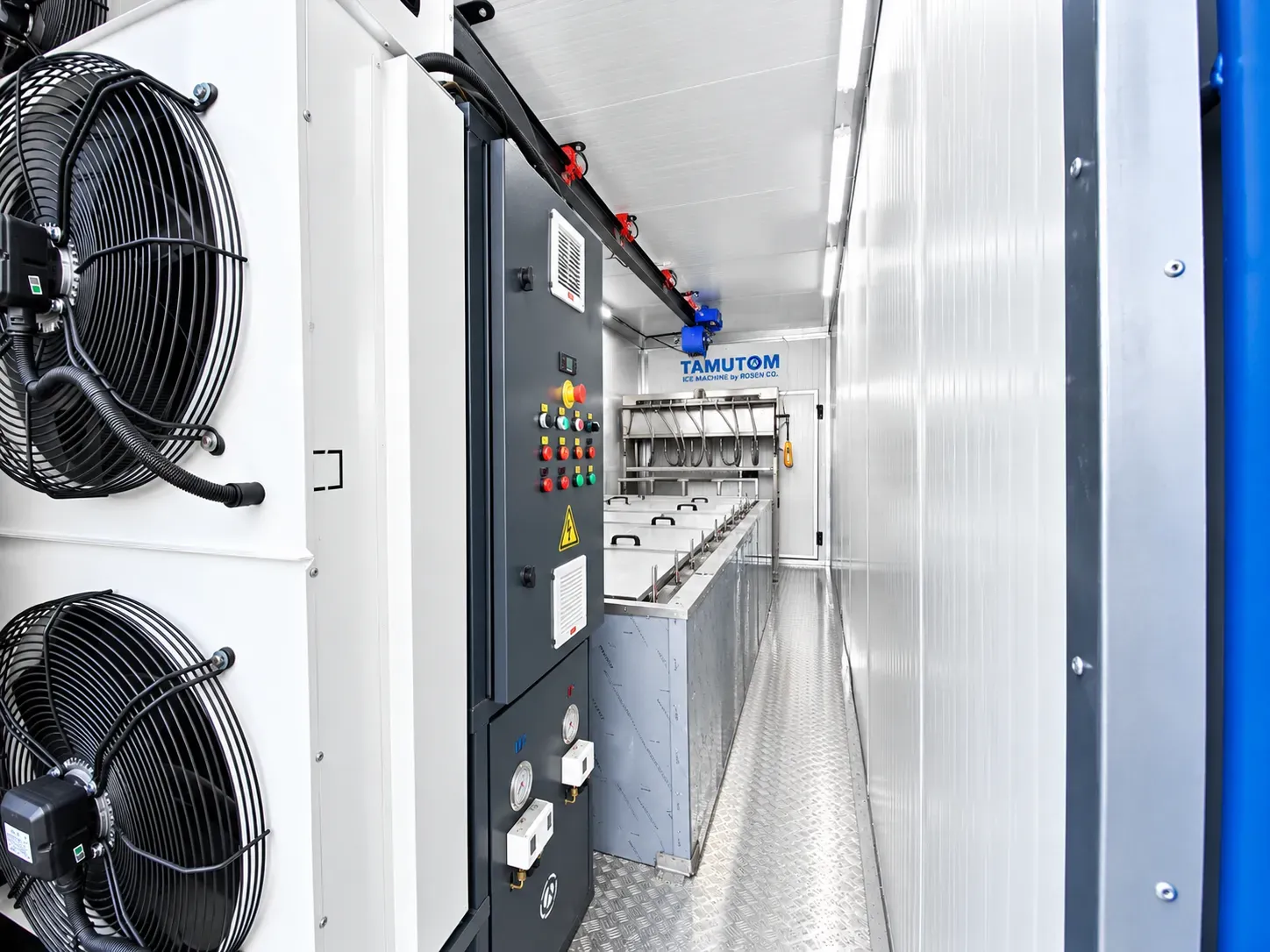
TAMUTOM BIM3TCOS addresses both requirements by combining a 3,000 kg/day block ice machine with an integrated cold storage room inside a 40 FT container.
Instead of treating ice manufacturing and storage as two separate investments, the system brings these essential functions together within one coordinated installation.
The result is a practical approach to ice supply management for businesses that need to produce ice regularly, maintain a reserve and organize deliveries according to changing daily demand.
The Difference Between Producing Ice and Having Ice Available
Imagine a fishing cooperative operating from a busy coastal harbor.
Several vessels leave early in the morning, while others return throughout the day. Ice demand is rarely distributed evenly across operating hours.
Some customers need their entire order at once. Others require smaller quantities at different times.
A conventional production-only system must be supported by suitable storage arrangements if ice is to be retained between production cycles and customer collection.
The BIM3TCOS approaches this requirement differently.
Its integrated configuration allows block ice production and refrigerated storage to be organized within the same containerized facility.
This provides businesses with an opportunity to separate the timing of ice production from the timing of ice distribution.
Ice can be produced according to the machine's operating schedule, while finished blocks can be held in the cold room until they are needed, subject to the available storage capacity and operating conditions.
For commercial ice suppliers, this distinction can make daily operations easier to coordinate.
The objective is not simply to produce three tons of ice per day. It is to make that production capacity more useful throughout the working day.
One Container, Two Essential Functions
The BIM3TCOS is designed around two complementary operations:
Block Ice Production
The machine produces solid ice blocks using an industrial brine-type refrigeration system.
Refrigerated Ice Storage
An integrated cold room provides a dedicated insulated area for holding finished ice before handling, collection or distribution.
Both functions are incorporated into a 40 FT containerized installation, allowing the production and storage processes to be planned as parts of the same facility.
This arrangement can be particularly valuable for businesses that do not have an existing cold storage room or that want to avoid planning separate locations for ice manufacturing and refrigerated holding.
The system does not eliminate the need for proper site preparation, ice handling procedures or operational planning. However, it provides a more integrated starting point for developing a local ice supply operation.
A Production Rhythm Designed for Everyday Commercial Demand
The BIM3TCOS has a nominal daily production capacity of 3,000 kg of block ice.
Its production process is based on standardized blocks weighing 12 kg each.
According to the published specifications:
-
3,000 kg/day: Nominal daily ice production capacity
-
84 blocks: Production per freezing cycle
-
12 kg: Weight of each ice block
-
7–8 hours: Approximate production cycle
-
252 blocks: Total daily block production
-
-12°C: Nominal ice temperature
Each production cycle produces 84 blocks weighing 12 kg, corresponding to 1,008 kg of ice.
Three complete cycles represent a calculated output of 3,024 kg per day, commercially expressed as a nominal capacity of 3,000 kg/day.
These figures give operators a practical basis for planning production.
For example, a supplier can organize ice harvesting around expected orders while using the integrated cold room to hold finished blocks awaiting collection.
A seafood business can coordinate ice availability with receiving and dispatch operations.
A fishing cooperative can establish a production schedule that considers the changing needs of its vessels.
Actual output and operating schedules depend on water temperature, ambient conditions, installation and operating practices.
Why Integrated Cold Storage Changes the Way an Ice Plant Operates
A cold room is not simply an additional compartment.
When incorporated into an ice production facility, it can influence how the entire business organizes its daily activities.
Production and Distribution Do Not Have to Follow the Same Schedule
Customers do not necessarily need ice at the exact moment a production cycle finishes.
An integrated cold room allows finished ice to be held under controlled refrigerated conditions while awaiting its next use.
This gives operators greater flexibility when coordinating production cycles and delivery times.
A More Organized Ice Handling Process
When ice manufacturing and storage take place within the same facility, the movement of finished blocks can be planned around a defined operational layout.
The objective is to establish an orderly process from ice harvesting to refrigerated holding and eventual dispatch.
Appropriate handling equipment and procedures must still be selected according to the installation.
Support for Fluctuating Customer Demand
Daily demand may change according to fishing activity, market schedules, seasonal conditions or customer orders.
A refrigerated storage area can help businesses manage the difference between the time ice is produced and the time it is required.
The amount of ice that can be retained depends on the cold room's usable storage capacity and the selected storage arrangement.
A Dedicated Environment for Finished Ice
Ice that is not immediately dispatched requires suitable storage conditions.
The integrated cold room provides an insulated refrigerated space intended for this purpose.
Proper temperature management, cleaning and hygienic handling procedures remain essential, particularly when ice is intended for food-related applications.
The Integrated Cold Room: Designed for Refrigerated Holding
The BIM3TCOS incorporates a cold storage compartment within its containerized configuration.
According to the published technical information, the cold room has the following characteristics:
-
Cold room dimensions: 300 × 200 × 250 cm
-
Insulation: 100 mm sandwich panels
-
Refrigeration: Dedicated cooling unit
-
Installation: Integrated within the containerized system
These dimensions provide a defined refrigerated space for organizing finished block ice storage.
The 100 mm sandwich-panel construction helps limit heat transfer between the refrigerated compartment and the surrounding environment.
The cooling unit supports the temperature-controlled operation of the storage space.
However, the amount of ice that can be stored depends on the internal arrangement, available usable volume, loading method and operational requirements.
The cold room's precise operating temperature and rated ice storage capacity should be confirmed during project planning.
Where Production and Storage Need to Work Together
Fishing Harbors: Ice Ready for Changing Vessel Schedules
Fishing activities rarely follow a perfectly predictable timetable.
Vessels may depart at different hours, return earlier than expected or require additional ice depending on the volume of their catch.
For fishing cooperatives and harbor-based suppliers, the ability to produce ice and maintain a refrigerated reserve can be an important operational advantage.
The BIM3TCOS allows these activities to be organized within a single containerized facility.
Its daily production capacity can support local supply requirements, while the integrated cold room provides a holding area for finished blocks awaiting use.
Seafood Processing: Supporting the Flow of Daily Operations
Seafood processing facilities may require ice during receiving, sorting, preparation and dispatch.
The quantity needed can vary throughout the working day.
By combining production with refrigerated storage, the BIM3TCOS can help businesses organize ice availability around these changing operational requirements.
The system may be integrated into a broader temperature-management process designed for the products being handled.
Commercial Ice Suppliers: From Manufacturing to Customer Collection
A commercial ice business must manage more than production.
Customer orders, collection times, transportation arrangements and temporary storage all affect daily performance.
The BIM3TCOS provides a production-and-storage configuration that can support these activities.
For a supplier serving several customers, finished ice can be held in the refrigerated compartment until collection or dispatch, within the limits of the available storage capacity.
Agricultural and Food Distribution Centers
Some agricultural and food distribution operations use ice as part of their product cooling processes.
In locations where regular ice deliveries are difficult to organize, a local production system with refrigerated holding capability may offer operational benefits.
The suitability of block ice must be evaluated according to the products, cooling requirements and applicable hygiene conditions.
Remote Commercial and Industrial Locations
Remote operating sites may face additional challenges when sourcing ice from distant suppliers.
Where suitable infrastructure is available, a containerized production-and-storage system can provide a local source of block ice.
Applications requiring crushed ice, automatic dosing or specialized conveying equipment may need additional systems beyond the standard machine configuration.
The Value of Solid 12 kg Ice Blocks
The BIM3TCOS produces solid blocks of ice weighing 12 kg each.
Block ice remains useful in applications where ice must be handled, transported or temporarily stored before use.
Its compact structure generally provides a lower surface-area-to-volume ratio than smaller ice particles.
Under comparable conditions, this means a solid ice block typically melts more slowly than crushed or finely divided ice.
For businesses managing commercial ice distribution, this characteristic can be useful when organizing temporary storage and transportation.
Standardized block weights also simplify quantity planning.
Instead of estimating an irregular volume of ice, operators can calculate requirements according to the number of blocks needed.
Where smaller ice pieces are required, suitable crushing equipment can be added separately.
Brine-Type Refrigeration Technology
The BIM3TCOS uses a brine-type freezing system for the production of solid block ice.
Water-filled molds are cooled through a refrigerated brine system until the water freezes into the required form.
The published refrigeration configuration includes:
-
15 HP compressor capacity
-
Air-cooled condenser
-
22,740 m³/h published condenser airflow
-
R404A refrigerant
-
380–415 V / 3 Phase / 50–60 Hz electrical supply
The system is designed to produce 84 blocks per cycle, with a nominal production time of 7–8 hours.
The air-cooled refrigeration equipment requires appropriate operating conditions and ventilation.
The cold storage compartment also has its own cooling requirements, which must be considered when planning the installation's overall electrical and refrigeration infrastructure.
A More Practical Way to Plan a Small Commercial Ice Facility
For businesses considering a new ice production investment, the central question is not always how to produce the greatest possible quantity.
It is how to establish a system that matches the rhythm of the business.
A local ice supplier may produce three tons per day but deliver that ice in several smaller quantities.
A fishing cooperative may experience high demand early in the morning and lower demand during the afternoon.
A processing facility may need ice at specific stages rather than continuously.
In each case, the relationship between production and storage matters.
The BIM3TCOS offers an integrated approach that allows businesses to evaluate these two requirements together.
Before installation, several practical questions should be considered:
How much ice is required each day?
Nominal production capacity should be matched with actual consumption and seasonal demand.
When will customers need the ice?
Collection and delivery schedules influence how finished ice should be handled.
How much ice needs to be stored?
The required reserve should be evaluated against the cold room's confirmed usable storage capacity.
What infrastructure is available?
The installation requires suitable electrical supply, water connections, drainage, ventilation, structural support and operational access.
Will additional equipment be necessary?
Depending on the application, ice handling, crushing, conveying or other auxiliary equipment may be required.
Answering these questions helps transform an equipment purchase into a properly planned ice production operation.
BIM3TCOS vs. BIM3TCO: Why the Cold Room Matters
Two ice machines can have the same nominal daily production capacity while serving different operational needs.
Both the TAMUTOM BIM3TCO and BIM3TCOS are designed around 3,000 kg/day nominal block ice production.
The key distinction is the installation concept.
The BIM3TCO is a containerized block ice production solution.
The BIM3TCOS combines block ice production with an integrated refrigerated storage compartment.
This difference can influence site planning, equipment selection and the organization of finished ice.
For businesses with an existing suitable cold storage facility, a production-focused system may be sufficient.
For those seeking to establish ice manufacturing and refrigerated holding within one containerized installation, the BIM3TCOS offers an alternative worth considering.
The appropriate choice depends on the customer's existing infrastructure, required storage capacity and daily operating model.
TAMUTOM BIM3TCOS – Produce Today. Keep It Ready for When It Matters.
A dependable ice supply operation is not defined only by the quantity of ice it can manufacture.
It also depends on how effectively finished ice can be managed between production and use.
The TAMUTOM BIM3TCOS Containerized Block Ice Machine with Integrated Cold Room brings these two essential functions together.
With a nominal production capacity of 3,000 kg/day, standardized 12 kg ice blocks, brine-type refrigeration technology and a 40 FT containerized configuration incorporating a refrigerated storage compartment, it offers a practical solution for businesses developing local ice production and supply operations.
From fishing harbors and seafood processing facilities to commercial ice distributors and remote industrial sites, the BIM3TCOS is designed around a simple operational principle:
Ice should not only be produced when the machine is running. It should be available when the business needs it.
Contact TAMUTOM to discuss the BIM3TCOS, its integrated cold storage configuration and the production, storage and installation requirements of your project.