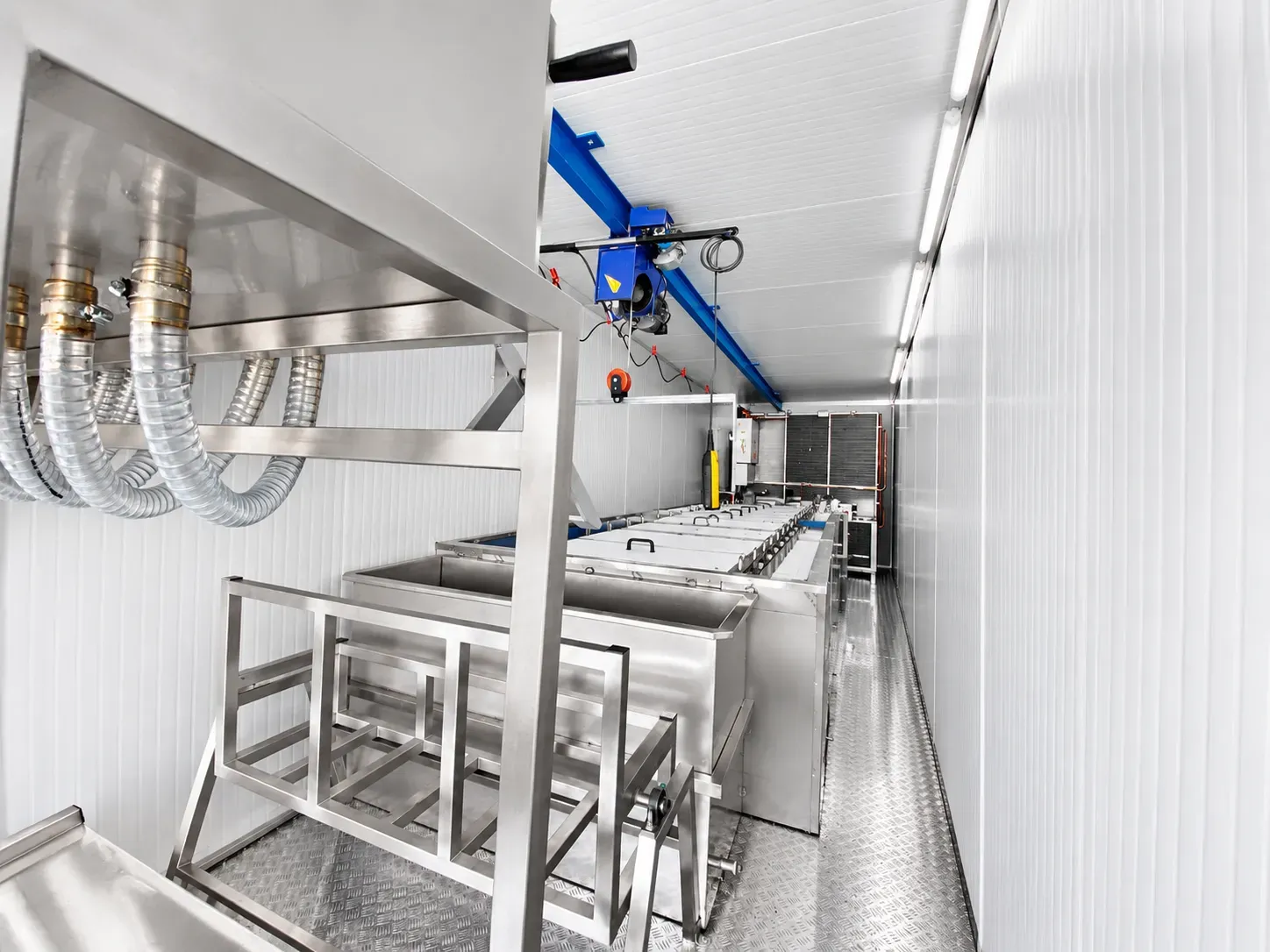
Ten Tons of Daily Ice Production Within a 40 FT Container
For businesses operating in high-demand ice markets, production capacity is only one part of a successful operation. The ability to coordinate manufacturing, harvesting, storage and distribution is equally important.
A commercial ice supplier serving multiple fishing vessels, seafood processing facilities or regional distributors must be able to plan production around substantial daily demand.
The TAMUTOM BIM10TCO Containerized Block Ice Machine is developed for operations requiring a nominal production capacity of 10,000 kg of solid block ice per day, combined with the practical advantages of a container-based installation.
The system integrates industrial brine-type ice production technology within an insulated 40 FT standard container, offering an alternative to conventional ice plants that require a dedicated building for the main production equipment.
With its high production volume and standardized 15 kg ice blocks, the BIM10TCO is particularly relevant to commercial ice manufacturers, major fishing ports, seafood distribution centers and industrial facilities requiring a substantial local ice supply.
10,000 kg/day: Production Capacity for High-Volume Ice Supply
When daily ice demand reaches several tons, production planning becomes a central part of the business.
Ice must be available at the right time, in the required quantity and in a form suitable for handling and delivery.
The BIM10TCO is designed around a structured production process with the following nominal characteristics:
-
10,000 kg/day: Nominal daily block ice production capacity
-
225 blocks: Ice production per cycle
-
675 blocks: Total daily block production
-
15 kg: Individual ice block weight
-
7–8 hours: Production cycle duration
-
12 × 21 × 70 cm: Published ice block dimensions
-
-12°C: Nominal ice temperature
Each production cycle produces 225 blocks weighing 15 kg each, corresponding to approximately 3,375 kg of ice.
Three complete cycles represent a calculated daily output of 10,125 kg, while the machine's commercial capacity is stated as a nominal 10,000 kg/day.
This production volume allows operators to organize substantial quantities of ice around planned harvesting and distribution periods.
For wholesale ice suppliers, the daily output can be allocated among multiple customer orders.
For fishing ports, production schedules can be coordinated with vessel departures and landings.
For seafood distribution centers, available ice quantities can be planned alongside receiving, processing and dispatch operations.
Rather than treating ice production as an isolated process, the BIM10TCO allows businesses to incorporate it into a broader commercial supply strategy.
A 40 FT Containerized Ice Plant: Industrial Capacity with an Integrated Layout
Increasing ice production capacity usually requires more space for refrigeration equipment, ice molds and operational activities.
The BIM10TCO addresses this requirement through a 40 FT standard insulated container, providing a defined enclosure for its main production equipment.
The container structure uses sandwich-panel insulation and accommodates the industrial refrigeration and block ice production system.
This approach offers several considerations for project planning.
An Alternative to a Dedicated Ice Production Building
A conventional ice factory may require the construction or adaptation of a building to accommodate the production machinery.
The BIM10TCO provides a containerized alternative in which the principal ice-making equipment is arranged within a standardized structure.
Depending on the site and project requirements, this may reduce the need for a separate building dedicated exclusively to the main production equipment.
Defined Equipment Arrangement
Integrating the system within a container allows the production equipment to be planned as a coordinated installation.
This can simplify certain aspects of equipment positioning and site layout compared with projects involving individually installed components.
Installation Close to Major Ice Consumers
For some businesses, the distance between an ice factory and its customers is a significant operational consideration.
A containerized plant can be evaluated for suitable sites near fishing ports, seafood markets, commercial distribution facilities or industrial operations.
Locating production closer to demand may help reduce dependence on long-distance ice deliveries.
Flexibility for Changing Business Requirements
The containerized format can offer greater flexibility when evaluating future changes in production location.
However, relocating the system requires suitable transport arrangements, equipment protection, site preparation and recommissioning.
A containerized design does not mean that the machine is self-powered or can operate without external infrastructure.
An appropriate electrical supply, water connection, drainage system, structural support and operational access remain necessary.
Industrial Ice Production as Part of a Distribution Network
At a daily capacity of 10 tons, the commercial value of an ice machine depends heavily on how efficiently the produced ice moves through the supply chain.
The production process must be supported by suitable arrangements for harvesting, handling, storage and delivery.
A typical operational sequence may be organized as follows:
Water Supply → Block Ice Production → Ice Harvesting → Handling → Storage or Direct Dispatch → Transportation → Customer Delivery
The most appropriate arrangement depends on the business model.
A company supplying fishing vessels may need to prepare ice for several boats within a limited departure window.
A regional wholesaler may divide daily production among customers located in different distribution areas.
An industrial facility may consume the ice internally according to its production schedule.
The BIM10TCO produces standardized 15 kg blocks, allowing finished ice quantities to be organized by individual units.
For example, a commercial supplier can plan customer allocations based on the number of blocks required for each order.
Where crushed ice is required, suitable ice crushing equipment can be incorporated separately into the overall installation.
Likewise, when production and delivery schedules do not coincide, dedicated ice storage capacity should be considered.
Where Does a 10-Ton Containerized Block Ice Machine Make a Difference?
Major Fishing Ports and Commercial Fishing Fleets
Commercial fishing operations frequently require substantial quantities of ice within relatively short periods.
Multiple vessels may need to load ice before departure, while freshly landed catches may require cooling during sorting, handling and transportation.
A local ice production facility can support the organization of these activities.
The BIM10TCO can be considered for major fishing ports, fishing cooperatives and coastal supply centers where daily ice demand justifies a higher-capacity production system.
Its nominal 10-ton capacity provides a basis for planning supply across multiple vessels and commercial customers.
Wholesale Ice Manufacturing and Regional Distribution
Businesses selling ice to multiple customers need to balance production volume with transportation and delivery capacity.
A 10-ton/day block ice plant may serve as the production center of a regional wholesale ice operation.
Potential customers can include fish markets, seafood traders, food distribution businesses and industrial users.
The commercial suitability of the investment depends on local demand, distribution distances, storage requirements and the ability to manage daily production.
Seafood Processing and Export Operations
Seafood processing and export activities involve coordinated receiving, preparation, handling and transportation schedules.
Ice may be required at different stages to support temperature management.
For businesses using block ice, establishing production close to processing or distribution activities may reduce dependence on external suppliers.
The BIM10TCO can provide a substantial source of solid block ice within a properly designed seafood handling and cold-chain operation.
Agricultural Collection and Food Distribution
Certain agricultural and food distribution processes use ice to support product cooling during handling or transportation.
A high-capacity ice production facility may be useful where several collection points or distribution operations require regular supplies.
The suitability of block ice should be evaluated according to the product, required cooling method and applicable hygiene standards.
Industrial and Infrastructure Projects
Large industrial projects may require substantial ice quantities for specific cooling processes.
In concrete cooling applications, ice can be incorporated into a properly engineered temperature-control system to help manage the temperature of fresh concrete.
However, the BIM10TCO produces solid ice blocks. Additional crushing, weighing, conveying and dosing equipment may be necessary before the ice can be used in a concrete batching process.
The complete cooling arrangement must be designed according to the concrete plant's technical requirements.
The Operational Advantages of 15 kg Block Ice
The physical form of ice can influence its handling, storage and transportation requirements.
Block ice is characterized by its solid, compact structure.
Compared with smaller ice particles, a solid ice block generally has a lower surface-area-to-volume ratio and tends to melt more slowly under comparable conditions.
This can be useful when ice must be transported or temporarily stored before use.
The BIM10TCO produces blocks weighing 15 kg each, at a nominal ice temperature of approximately -12°C.
Standardized block weights can support commercial operations in several ways.
Ice quantities can be counted and allocated according to customer orders.
Handling and loading procedures can be organized around consistent units.
Whole blocks can be supplied directly where appropriate or processed into smaller pieces using separately selected crushing equipment.
The choice between whole block ice and crushed ice depends on the final application and the customer's operating requirements.
Brine-Type Block Ice Production Technology
The BIM10TCO uses a brine-type refrigeration system to manufacture solid ice blocks.
In this production method, water-filled molds are cooled through a refrigerated brine system until the water freezes into the required block form.
The machine is designed to produce 225 blocks per cycle, with a nominal freezing period of 7–8 hours.
Its published refrigeration configuration includes:
-
60 HP compressor capacity
-
Air-cooled condenser
-
39,016 m³/h published condenser airflow
-
R404A refrigerant
-
380–415 V / 3 Phase / 50–60 Hz electrical supply
These components form part of an industrial production system arranged within the insulated container structure.
The air-cooled condenser requires appropriate ventilation and operating conditions. Site planning should therefore consider ambient temperatures, airflow and the manufacturer's installation requirements.
Planning a 10-Ton Containerized Ice Production Facility
Investing in a higher-capacity ice machine requires careful consideration of the entire production operation.
Before selecting the BIM10TCO, businesses should evaluate several factors that influence the performance and commercial suitability of the installation.
Understanding Daily and Seasonal Demand
Does the business require 10 tons of ice every day, or does demand increase during particular seasons?
Fishing activity, market conditions and industrial production schedules may create significant fluctuations in ice consumption.
Production capacity should be selected according to realistic demand and expected business development.
Coordinating Production Cycles
The BIM10TCO operates with nominal production cycles of 7–8 hours.
Businesses should consider when finished ice will become available and how these times align with customer collection or delivery schedules.
Planning Ice Storage
Production and consumption do not always occur simultaneously.
If ice must be retained between production and dispatch, suitable storage facilities should be included in the project.
Storage capacity should be evaluated according to expected holding periods, daily demand fluctuations and the selected handling method.
Preparing the Installation Site
The 40 FT container requires a properly prepared installation area.
Site planning should consider electrical infrastructure, water availability, drainage, structural support, ventilation and sufficient access for operation and maintenance.
Transport and unloading arrangements must also be evaluated before delivery.
Selecting Supporting Equipment
Depending on the application, the complete ice production facility may require additional equipment for harvesting assistance, handling, crushing, storage or transportation.
Such components should be evaluated separately rather than assumed to be included in the standard machine configuration.
Choosing Between Containerized and Conventional High-Capacity Ice Production
Businesses planning commercial ice production often need to decide not only how much ice to manufacture but also how to organize the production facility.
A conventional industrial installation may be appropriate when the project includes an existing production building or requires a customized equipment layout.
A containerized system can offer an alternative where a standardized equipment enclosure is desirable.
The BIM10TCO occupies an important position in this comparison.
With its 10,000 kg/day nominal capacity, it provides substantially greater output than smaller containerized models while retaining the advantages of a container-based production layout.
For businesses considering expansion, this makes the BIM10TCO a relevant option when evaluating the relationship between production volume, available installation space and distribution requirements.
The final selection should be based on a technical and commercial assessment of the complete project.
From Production Capacity to a Reliable Ice Supply Operation
At 10 tons per day, the effectiveness of an ice production investment depends on more than the machine's nominal output.
The ability to provide ice consistently, organize production cycles and coordinate deliveries is essential to the overall operation.
A suitable installation should therefore be planned around three connected priorities:
Production: Generating the required quantity of ice according to a defined schedule.
Handling and Storage: Managing finished ice between harvesting and final use.
Distribution: Delivering the required quantities to customers or internal operating areas.
The BIM10TCO provides the production capacity around which these activities can be organized.
By integrating a high-capacity brine-type block ice machine within a 40 FT insulated container, TAMUTOM offers an alternative for businesses developing substantial commercial ice supply operations.
TAMUTOM BIM10TCO – Industrial Ice Production on a 10-Ton Scale
The TAMUTOM BIM10TCO Containerized Block Ice Machine combines 10,000 kg/day nominal ice production capacity, standardized 15 kg blocks, industrial brine refrigeration technology and a 40 FT insulated container structure.
It is designed for businesses seeking to establish or expand high-volume block ice production while maintaining a containerized installation approach.
From commercial fishing ports and seafood distribution centers to wholesale ice manufacturers and industrial facilities, the BIM10TCO provides a production solution that can be integrated into a broader ice supply operation.