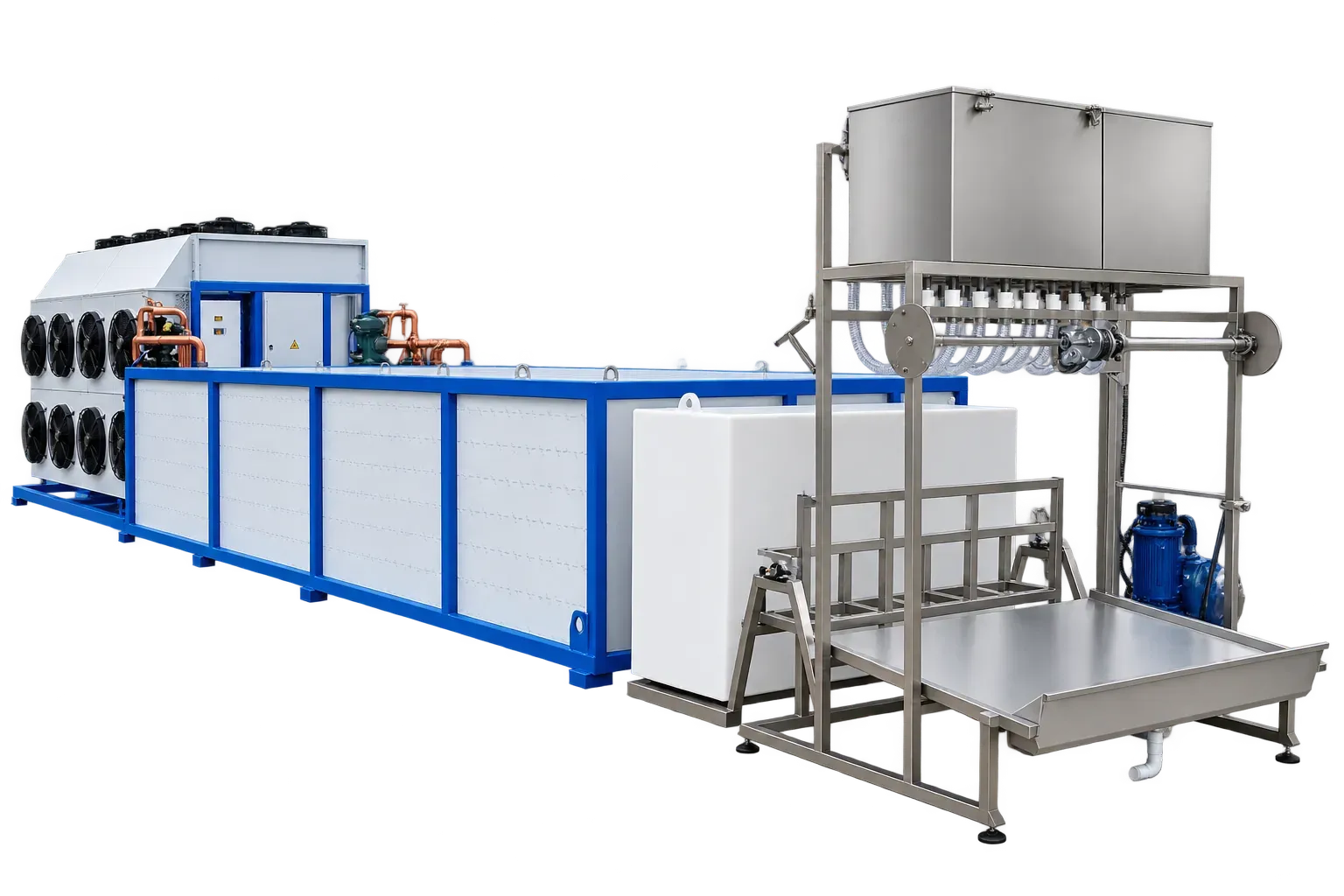
800 Ice Blocks a Day: Predictable Production Capacity
In industrial ice manufacturing, daily capacity delivers real commercial value only when translated into precise production and delivery logistics.
The nominal production values for the BIM20T are as follows:
-
20,000 kg: Total daily ice production capacity
-
800 blocks: Daily block ice output across two complete cycles
-
400 blocks: Ice blocks produced in a single 12-hour cycle
-
25 kg: Weight of each individual ice block
Each block measures approximately 12 × 21 × 70 cm. The standardized block dimensions streamline handling, storage, and transport logistics.
Approximately 10 tons of ice are harvested per production cycle. Operating over a 24-hour cycle allows the plant to consistently reach its nominal 20-ton daily target.
This organized schedule enables plant operators to efficiently align production with client orders, fishing vessel departures, loading workflows, and distribution needs.
The BIM20T elevates ice production from a simple manufacturing task into the backbone of a scheduled, commercial ice supply operation.
Commercial and Operational Advantages of 25 kg Ice Blocks
Not every cooling requirement benefits from rapid-melting or crushed ice.
In many industrial and commercial applications, the priority is to obtain solid, dense ice blocks that can be transported, stored, and utilized for long-lasting cooling over extended periods.
Block ice stands out due to its solid, integrated structure and relatively low surface-area-to-volume ratio.
Compared to smaller ice forms, large solid blocks melt significantly slower under similar conditions. This makes block ice optimal for transit, temporary storage, and long-distance handling.
The BIM20T produces dense block ice at a nominal temperature of around -12°C.
The standardized 25 kg block size provides a practical balance between manual handling and bulk commercial distribution.
Depending on the end-use application, blocks can be utilized whole or reduced into smaller pieces using dedicated ice-crushing equipment.
This operational versatility is a major commercial asset for facilities catering to diverse industry sectors from a single manufacturing hub.
One Ice Facility, Serving Multiple Industries
Commercial Ice Production & Wholesale Distribution
For commercial ice suppliers, total production volume directly governs market reach and growth potential.
A block ice facility with a daily output of 20 tons serves as an ideal supply hub for wholesale distribution across cities, coastal regions, or industrial zones.
Target markets include commercial fisheries, seafood traders, food logistics firms, agricultural distributors, and heavy ice consumers.
The BIM20T helps operators establish structured daily routines and synchronize harvest times directly with client fulfillment schedules.
Supported by appropriate cold storage and transport infrastructure, businesses can organize production cycles to match peak demand periods and scheduled deliveries seamlessly.
Fishing Ports and Commercial Fleets
Ice demand at fishing ports typically surges during specific operational windows.
Multiple vessels may require rapid bunkering before setting sail, while arriving fleets need immediate ice for offloading, sorting, and preserving catch quality.
This creates sharp demand spikes requiring heavy ice volumes over short timeframes.
A high-capacity block ice system provides the necessary infrastructure to feed multiple marine operations from a centralized facility.
The BIM20T is an effective solution for commercial fishing harbors, cooperatives, collection hubs, and coastal ice suppliers.
Reliable access to large ice volumes preserves seafood freshness during handling and transit, maintaining strict temperature controls.
Seafood Processing and Export Logistics
Throughout seafood supply chains, harvesting, handling, processing, and shipping require precise thermal management.
In facilities relying on block ice for cold preservation, industrial capacity ensures uninterrupted supply chains.
The BIM20T is designed for processing plants, fish wholesalers, and cold-chain logistics providers requiring reliable ice generation.
The standard 25 kg block format integrates easily with commercial transport equipment and handling systems built for these dimensions.
When crushed ice is needed, compatible crushing machinery can be seamlessly integrated into the facility's overall processing and distribution setup.
Produce Wholesale Markets & Food Distribution
Large agricultural wholesale hubs and fresh produce hubs consume vast amounts of ice for long-haul shipping and storage.
Block ice serves as a portable thermal reservoir for long routes and multi-stop delivery trucks.
For ice suppliers serving agricultural sectors, the BIM20T provides a dependable, high-volume production line.
Construction and Concrete Cooling Applications
During hot-weather concrete pouring, ice is integrated into mixing processes to control hydration temperatures and prevent structural cracking.
Large infrastructure projects require variable ice volumes depending on mix design, ambient temperatures, and daily pour rates.
The BIM20T can serve as a central ice source for concrete batching plants that specify block ice cooling.
Auxiliary equipment—such as crushers, weighing units, and automated dosing conveyors—may be required to feed ice into batch mixers.
System integration should be tailored to the batching plant's specific operational requirements.
Industrial Block Ice Production via Brine System
The BIM20T operates using the time-tested brine cooling method.
Water-filled ice cans are immersed in chilled brine, transferring heat efficiently until the water freezes solid into durable blocks.
The freezing cycle proceeds systematically, freezing hundreds of ice blocks concurrently.
The BIM20T features a nominal 12-hour freezing cycle, harvesting 400 blocks per cycle.
The refrigeration system is powered by a 120 HP compressor capacity paired with an air-cooled condenser.
According to technical specifications, the unit operates on a 380–415 V, 3 Phase, 50–60 Hz power supply using R404A refrigerant.
Brine-based freezing remains one of the most reliable and efficient methods for producing heavy, solid block ice on an industrial scale.
From Production Capacity to Complete Supply Operations
A high-capacity ice machine is a core asset of an industrial facility, but it requires supporting infrastructure to function at peak efficiency.
Fully utilizing a 20-ton daily capacity requires well-planned facility workflows and auxiliary systems.
Water feed, power supply, harvesting routines, handling equipment, storage, and dispatch logistics must operate in harmony.
A typical commercial workflow follows this sequence:
Water Supply → Ice Block Freezing → Block Harvesting → Transport & Storage → Dispatch & Client Delivery
Facility layout depends on production targets, available footprint, labor organization, and client demand schedules.
For instance, a port facility may schedule harvests around early morning boat departures and afternoon landings.
A wholesale supplier might structure cycles to align with fleet loading times.
In concrete cooling, ice harvesting must match batching plant pouring schedules continuously.
Regardless of the application, the primary goal remains identical: Having sufficient ice ready precisely when needed.
The BIM20T delivers the core output needed to build a successful, large-scale commercial ice supply business.
Planning a 20 Ton/Day Block Ice Plant
Selecting an industrial block ice machine requires evaluating complete operational and commercial goals, not just machine output.
Before launching a new plant or expanding capacity, several key operational parameters should be thoroughly analyzed.
What Is Your Daily Target Output and Sales Volume?
A 20-ton capacity should be evaluated against real market demand, seasonal peaks, and projected business growth.
Aligning output capabilities with sales goals prevents underutilization and optimizes operating costs.
When Is Peak Demand From Your Clients?
Demand may spike during vessel departures, transport loading hours, or specific factory shifts.
Understanding these peak windows determines how harvesting, storage, and logistics should be organized.
How Will Ice Blocks Be Handled and Transported?
Harvesting 800 blocks daily requires efficient material handling, internal transport, temporary storage, and truck loading systems.
Designing efficient workflows and selecting proper handling tools ensures smooth plant operations.
Will Ice Be Delivered Whole or Crushed?
Some customers require solid 25 kg blocks, while others need crushed or chipped ice.
This requirement dictates whether ice crushers and specialized loading equipment must be added to the layout.
Is Additional Cold Storage Required?
Since production and demand schedules rarely align perfectly, temporary storage solutions should be planned to buffer inventory.
Is Site Infrastructure Fully Prepared?
Electrical capacity, water supply, equipment access, floor space, and ambient conditions must be evaluated prior to installation.
Addressing these factors early guarantees smooth installation and long-term operational success.
TAMUTOM BIM20T: Industrial Output for Growing Ice Operations
Investing in a 20 ton/day block ice machine is a strategic step toward expanding commercial capacity.
Whether building a wholesale ice business, scaling up factory output, supplying fishing fleets, or establishing regional supply networks, success relies on consistent high-volume output.
TAMUTOM BIM20T combines a 20,000 kg nominal capacity with standard 25 kg blocks and a reliable 12-hour production cycle.
These features make the BIM20T an ideal choice for industrial businesses seeking predictable output aligned with commercial distribution.
Whether supplying harbors, seafood processors, agricultural supply chains, or operating an independent ice factory, the BIM20T delivers the performance required for high-volume success.
Frequently Asked Questions
The Tamutom BIM20T features a nominal daily production capacity of 20,000 kg (20 tons) using a brine cooling system. This output yields 800 blocks of ice per day across two 12-hour production cycles.
Each block of ice produced weighs 25 kg and measures approximately 12 x 21 x 70 cm. This standardized block size offers superior operational efficiency during handling, storage, and transport.
The BIM20T is widely utilized by wholesale ice suppliers, fishing ports, seafood processors, agricultural markets, food distribution hubs, and concrete cooling operations on major construction projects.