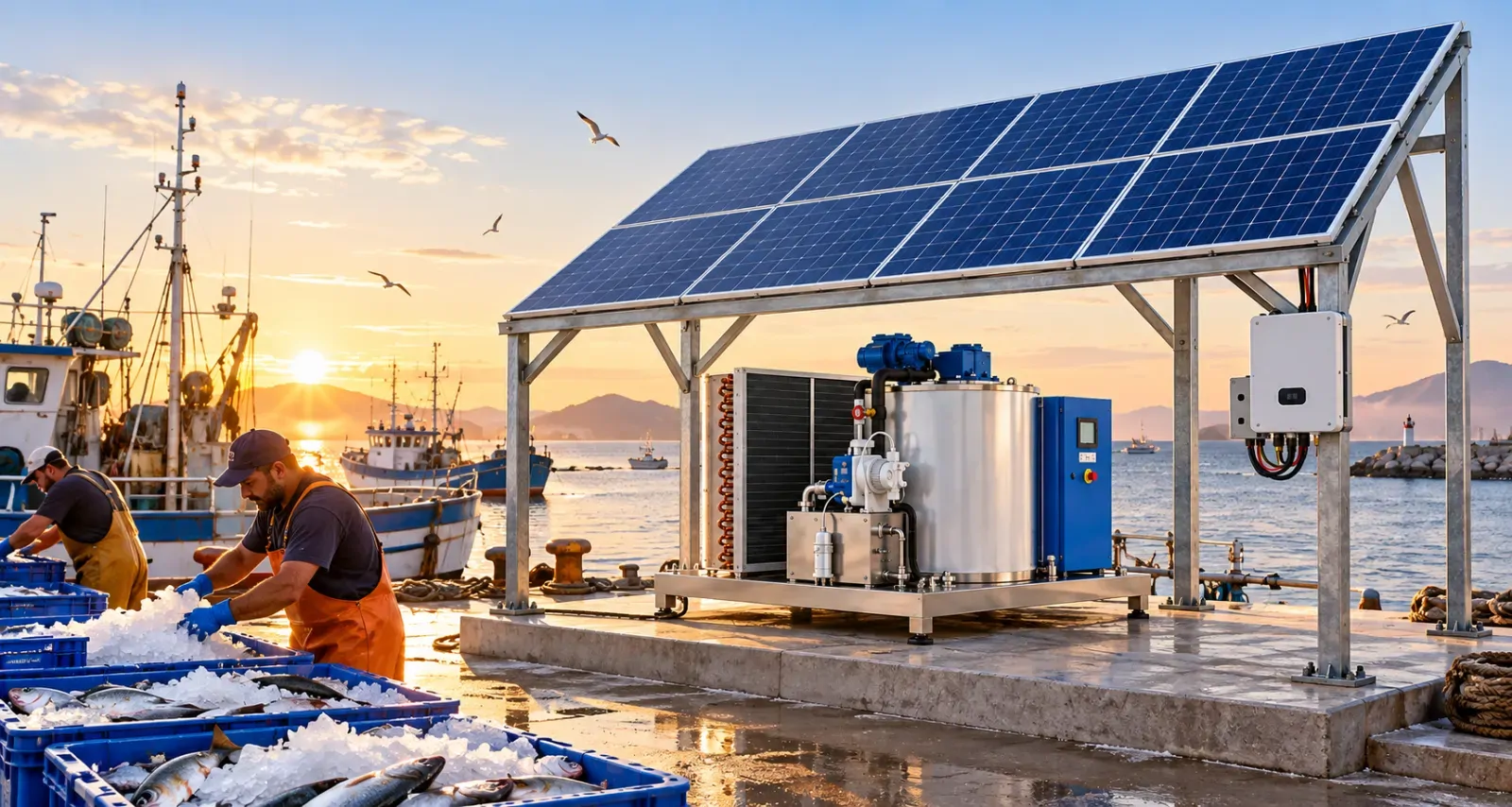
TAMUTOM's vision for off-grid and solar-focused industrial ice production.
🌐General Manager's Perspective
In many parts of the world, the main issue is not merely producing ice efficiently. The more fundamental question is: How can ice be produced in places where there is no reliable source of electricity?
For fishing communities, remote food processing plants, agricultural enterprises, and isolated settlements, the absence of a stable electrical grid can make establishing conventional cooling infrastructure difficult or economically unfeasible.
Over the years, TAMUTOM has developed and supplied industrial refrigeration and ice production solutions for markets with challenging operating conditions, including Kenya, Nigeria, Mali, Canada, the Middle East, and other regions where electricity is unavailable, intermittent, or high-cost.
From Grid-Dependent Machines to Energy-Adaptive Ice Systems
A conventional ice machine is mostly designed under a single assumption: electricity is available whenever the machine needs it. In remote regions, this assumption may not hold true. Power might be supplied for only a few hours a day; diesel fuel can be expensive or difficult to transport; voltage can fluctuate significantly, and in some locations, an electrical grid connection may not exist at all.
For this reason, TAMUTOM’s engineering approach focuses on energy efficiency, energy source flexibility, and simplicity. Instead of installing a massive battery bank to simulate a traditional 24-hour power supply, another solution is possible: producing ice when energy is available and storing the energy in the form of ice.
☀️ How Does Thermal Energy Storage Logic Work?
During daytime hours, solar radiation is converted into electricity by photovoltaic panels. This electricity powers the machine directly. Water freezes into ice, and the produced ice becomes an excellent thermal energy storage medium. In fisheries, ice continues to preserve the freshness of caught products long after the sun sets. This approach eliminates or significantly reduces the need for expensive and short-lived chemical battery storage.
A Practical Example: TAMUTOM FIM500 Solar Energy Concept
As part of recent engineering studies, TAMUTOM evaluated how the compact 500 kg/day Solar Powered Flake Ice Machine (TAMUTOM FIM500-SP) model could be configured in a remote area without an electrical grid.
The nominal production capacity of the machine is 500 kg per 24 hours. However, in a setup powered purely by solar energy, the target does not necessarily have to be 24-hour continuous operation. For many fishery applications in remote areas, generating even around 160–200 kg of fresh flake ice during daylight hours adds valuable capacity to the local cold chain.
TAMUTOM FIM500 Solar Configuration Table
| System Component | Recommended Engineering Configuration |
|---|---|
| Ice Machine Model | TAMUTOM FIM500-SP |
| Nominal Ice Capacity | 500 kg / 24 hours (Grid-connected) |
| Electrical Connection | 230 V / Single-phase |
| Solar Panel Array Power | Approx. 6.05 kWp |
| Solar Panel Count & Rating | 11 Units × 550 W Monocrystalline Panels |
| Typical Panel Dimensions | Approx. 2278 × 1134 mm each |
| Solar Inverter Power | Approx. 6.2 kW, 230 V Single-phase |
| Inverter Type | Off-Grid / Hybrid, suitable for battery-free operation |
| Battery Storage | Not Required (for daytime direct production only) |
| Generator Connection | Can be integrated as optional backup power |
| Expected Solar Operating Time | Approx. 8–10 hours/day (depending on location and weather) |
| Estimated Daytime Production | Approx. 160–200 kg / day (purely on solar energy) |
Why Must Solar Panel Array Power Exceed Operational Load?
A solar-powered cooling system must not be sized based solely on the nominal running power of the compressor. In real field conditions, systems like the FIM500-SP must be engineered taking the following factors directly into account:
1. Climate and Temperature Losses
In hot climates, a panel rated at 550 W under Standard Test Conditions (STC) cannot continuously yield 550 W in the field due to high cell temperatures.
2. Inrush Currents
Industrial refrigeration compressors demand 3 to 5 times higher startup (inrush) current compared to normal running state. The inverter must handle this surge.
3. Auxiliary Equipment Consumption
Condenser fans, water pumps, circulation motors, and electronic control boards must also be factored into instantaneous power draw.
4. Irradiance Variations and Inverter Losses
Safety margins must be allowed for momentary cloud passages, changing solar angles, and DC-to-AC conversion losses.
For these reasons, TAMUTOM prefers a safe engineering margin based on field realities rather than theoretical minimum capacities.
Battery-Free Design — Generator Support When Needed
One of the key conclusions of our R&D work: Massive battery banks are not always mandatory.
The architecture for daytime production is remarkably simple:
When solar irradiance becomes insufficient, production stops. If additional ice production is required at night, a diesel generator can be engaged via an appropriate transfer switch or hybrid inverter.
💰 Why Choose a Battery-Free System?
Instead of storing 40–50 kWh of electricity in a costly and short-lived battery bank, storing energy directly in the form of ice significantly reduces capital expenditure (CAPEX), battery replacement risks, and maintenance complexity.
Engineered for Harsh Operating Conditions
The real challenge is not merely running a refrigeration compressor with photovoltaic panels. The entire installation must operate reliably in regions where technical support, spare parts, and advanced infrastructure are limited.
TAMUTOM engineering priorities:
- ✓ Low Power Consumption: Compressor and evaporator design with high COP values.
- ✓ Simple Electrical Architecture: Control panels that prevent complex failures and allow easy field intervention.
- ✓ Stainless Steel Construction: Frame resilient to seawater, humidity, and corrosive outdoor environments.
- ✓ High Adaptability: Full integration with both standard industrial machines in our flake ice machine category and solar systems.
Why Is This Technology Vital for the Fishing Industry?
In fisheries, ice is not a luxury; it is basic infrastructure. In the absence of ice, every hour that passes between catch and market delivery degrades product quality and damages commercial value. Local solar-powered ice production directly supports fish landing sites, coastal cooperatives, and island fisheries.
TAMUTOM's Vision
We believe next-generation ice machines will not be evaluated solely by the quantity of ice they produce. Their energy consumption, ease of integration with renewable energy, independent operation capability, and reliability in harsh environments will also be decisive.
Our goal is not simply to manufacture an ice machine and connect solar panels to it. We aim to develop smart ice production systems that adapt to available energy sources.
"Where water and sunlight exist, the absence of a conventional electrical grid should no longer mean the absence of ice."
Mustafa GÖĞCÜ
General Manager / CEO — TAMUTOM