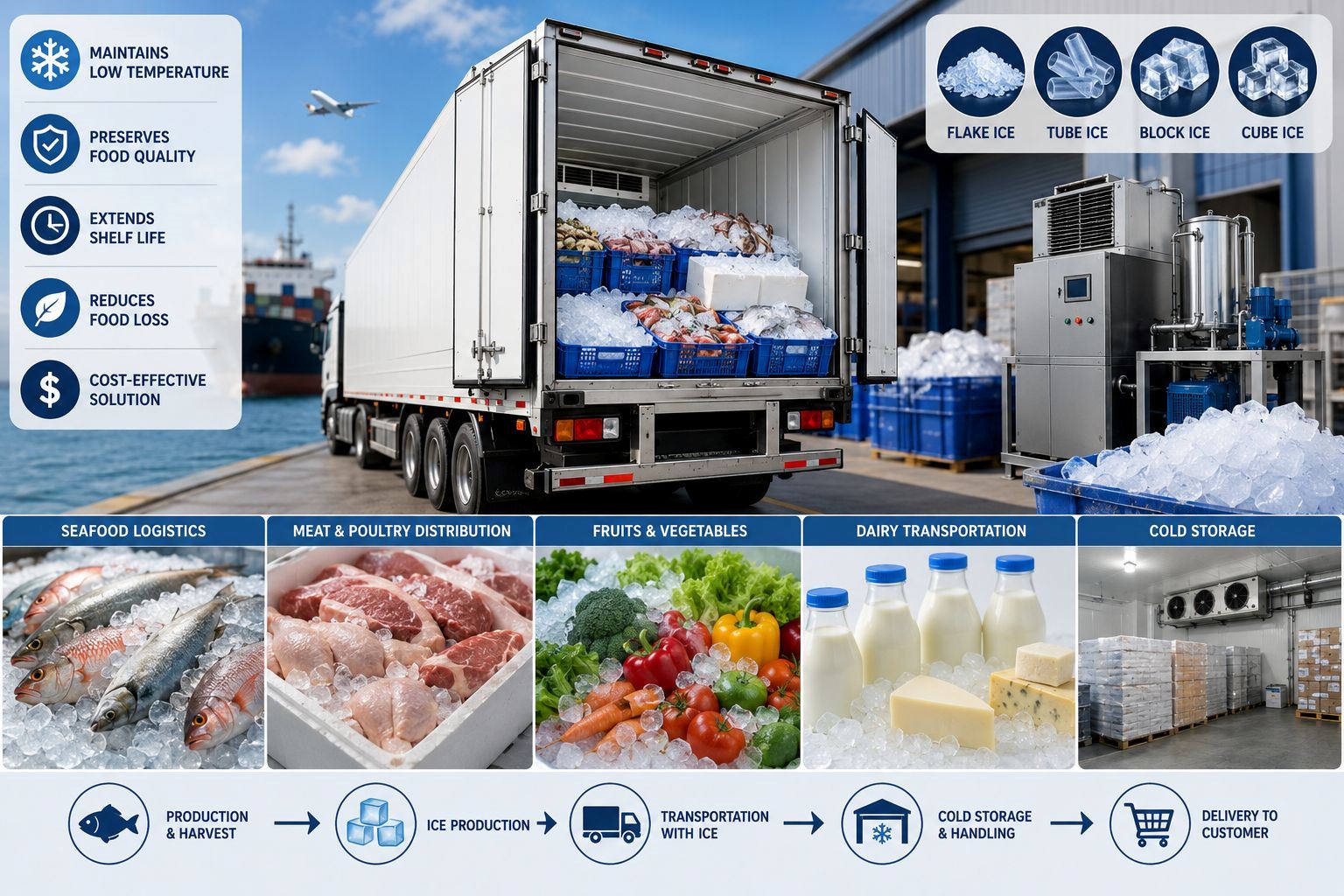
Why Ice Remains Essential in Modern Food Logistics
Food logistics is one of the most critical sectors in the global supply chain. From seafood and meat to fresh produce and dairy products, maintaining the correct temperature during transportation and storage is essential for preserving product quality, extending shelf life, and complying with food safety regulations.
While refrigerated vehicles and cold storage facilities play a major role, ice remains one of the most reliable and cost-effective cooling solutions throughout the cold chain.
In this article, we explore how industrial ice solutions support food logistics operations and why choosing the right ice system can significantly improve product quality and operational efficiency.
The Importance of Temperature Control in Food Logistics
Temperature fluctuations can have serious consequences during transportation and storage, including:
- Reduced product shelf life
- Bacterial growth and contamination risks
- Product dehydration and weight loss
- Quality deterioration
- Increased financial losses
Maintaining a stable temperature from production to delivery is essential for protecting food products and ensuring customer satisfaction.
Why Ice Is Still a Preferred Cooling Solution
Despite advances in refrigeration technology, ice continues to be widely used in food logistics because it offers several advantages:
Direct Cooling
Ice provides direct contact cooling, allowing products to reach and maintain the desired temperature quickly.
Energy Efficiency
Ice can reduce the workload on refrigeration systems, lowering overall energy consumption during transportation and storage.
Reliable Backup Cooling
In the event of refrigeration equipment failure, ice provides an additional layer of temperature protection.
Cost-Effective Operation
For many logistics applications, ice remains one of the most economical cooling methods available.
Best Ice Types for Food Logistics
Different food products require different ice solutions.
Flake Ice
Flake ice is one of the most commonly used ice types in food logistics.
Applications:
- Seafood transportation
- Fresh fish distribution
- Poultry processing
- Fresh produce storage
Benefits:
- Rapid cooling
- Excellent product coverage
- Minimal product damage
- Easy handling
Tube Ice
Tube ice is ideal for logistics operations that require longer cooling periods.
Applications:
- Packaged food transportation
- Beverage distribution
- Cold storage facilities
Benefits:
- Slow melting rate
- High cooling capacity
- Easy transportation
Block Ice
Block ice is commonly used for long-distance transportation and operations in hot climates.
Applications:
- Fishing vessels
- Remote logistics operations
- Large-scale food distribution
Benefits:
- Extended cooling duration
- Low melting rate
- Suitable for tropical environments
Ice Applications Across the Food Supply Chain
Seafood Logistics
Fresh seafood is highly temperature-sensitive and requires immediate cooling after harvesting.
Ice helps:
- Maintain freshness
- Prevent bacterial growth
- Extend shelf life
- Preserve appearance and texture
Meat and Poultry Distribution
Maintaining low temperatures during processing and transportation is essential for food safety.
Ice supports:
- Temperature stabilization
- Reduced spoilage
- Improved product quality
Fruit and Vegetable Logistics
Fresh produce continues to respire after harvesting, generating heat that accelerates spoilage.
Ice solutions help:
- Remove field heat
- Slow biological activity
- Maintain freshness during transport
Dairy Product Transportation
Ice can be used as a supplemental cooling solution during transportation and temporary storage, helping maintain product integrity.
Choosing the Right Ice Plant for Food Logistics
When selecting an ice production system, companies should evaluate:
Production Capacity
The ice plant must match daily logistics requirements while allowing room for future growth.
Ice Type
Different products require different cooling characteristics.
Climate Conditions
Ambient temperature, humidity, and transportation distance should all be considered.
Energy Efficiency
High-efficiency refrigeration systems reduce long-term operating costs.
Automation and Reliability
Modern automated ice plants provide consistent production and minimize maintenance requirements.
Future Trends in Food Logistics Cooling
As global food distribution networks continue to expand, demand for efficient and sustainable cooling solutions is increasing.
Emerging trends include:
- Automated ice production systems
- Smart monitoring technologies
- Energy-efficient refrigeration systems
- Containerized ice plants
- Environmentally friendly refrigerants
These innovations help logistics operators improve efficiency while reducing operational costs.
Ice remains a critical component of modern food logistics. Whether transporting seafood, meat, dairy products, or fresh produce, the right ice solution helps maintain product quality, ensure food safety, and reduce losses throughout the cold chain.
By selecting the appropriate ice type and investing in a reliable industrial ice production system, logistics companies can enhance operational performance while meeting increasingly demanding food safety standards.